In our world today, towns are changing continuously, moment by moment, with the flow of time. In this corner, we stand at one location and present fixed-point observations showing how the townscape has changed from past to present. Places that have changed, places that haven’t changed—memories unique to each person come back to life.
*Click on each image to enlarge it.
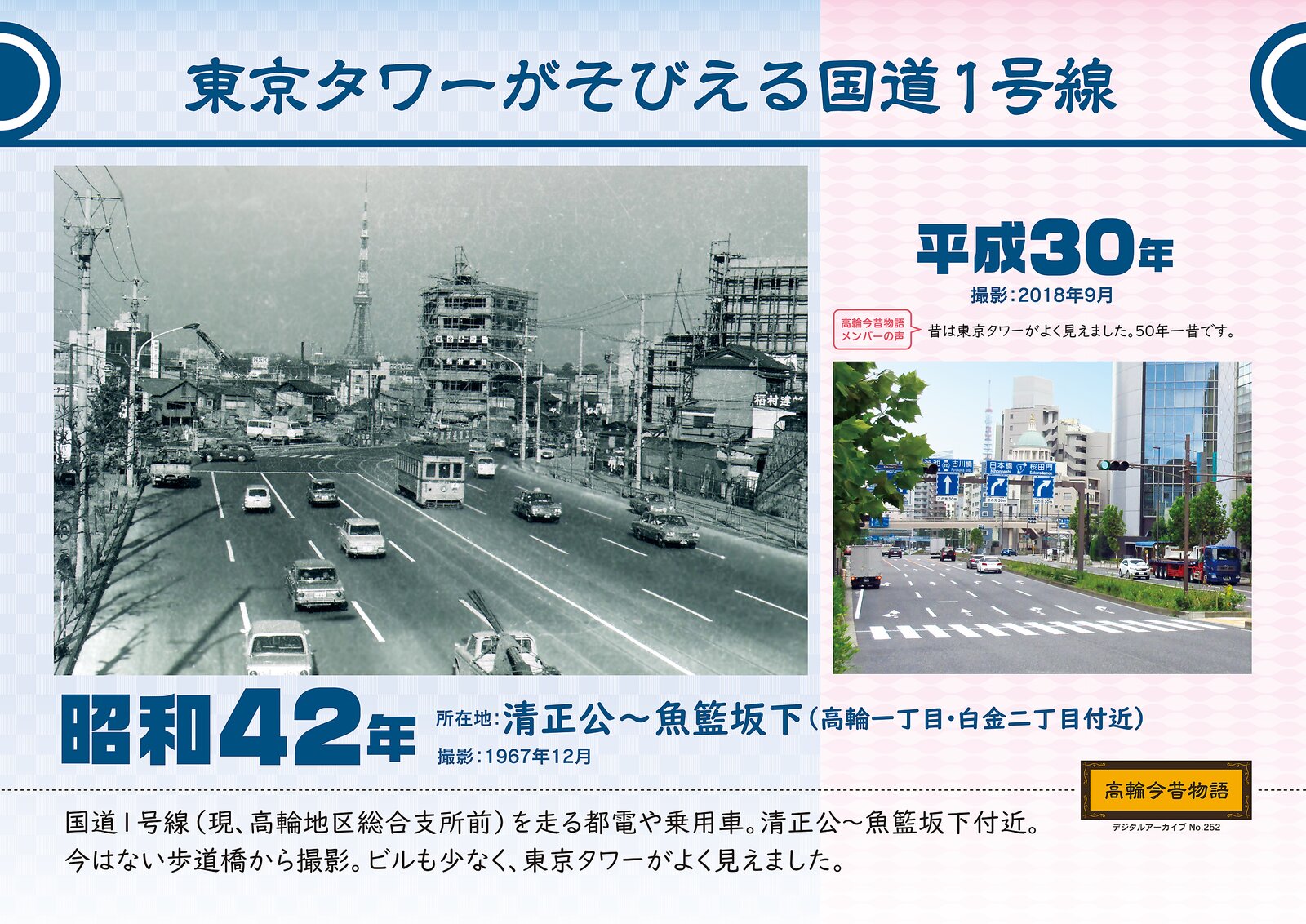
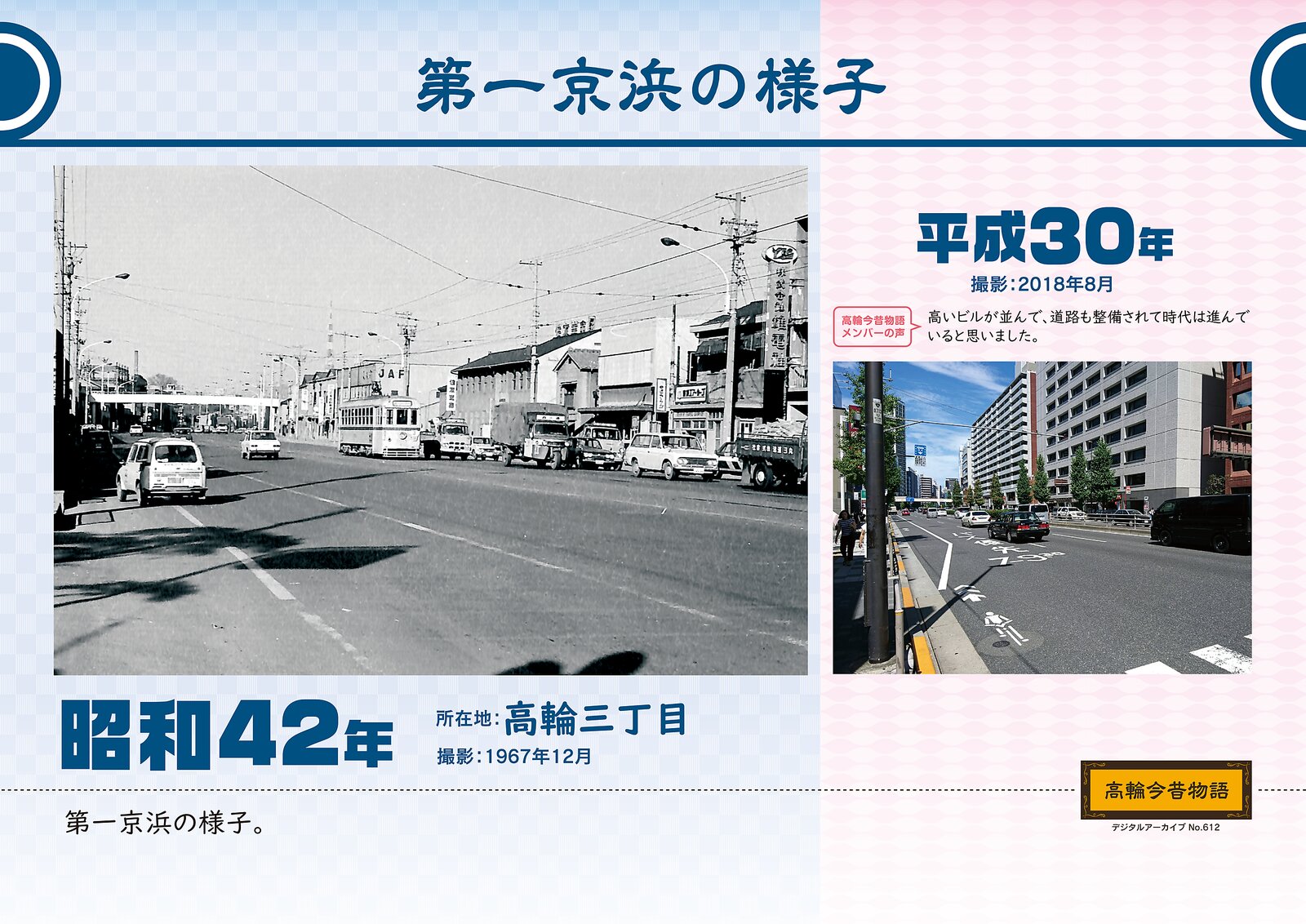
National Route 1, with Tokyo Tower soaring over it.
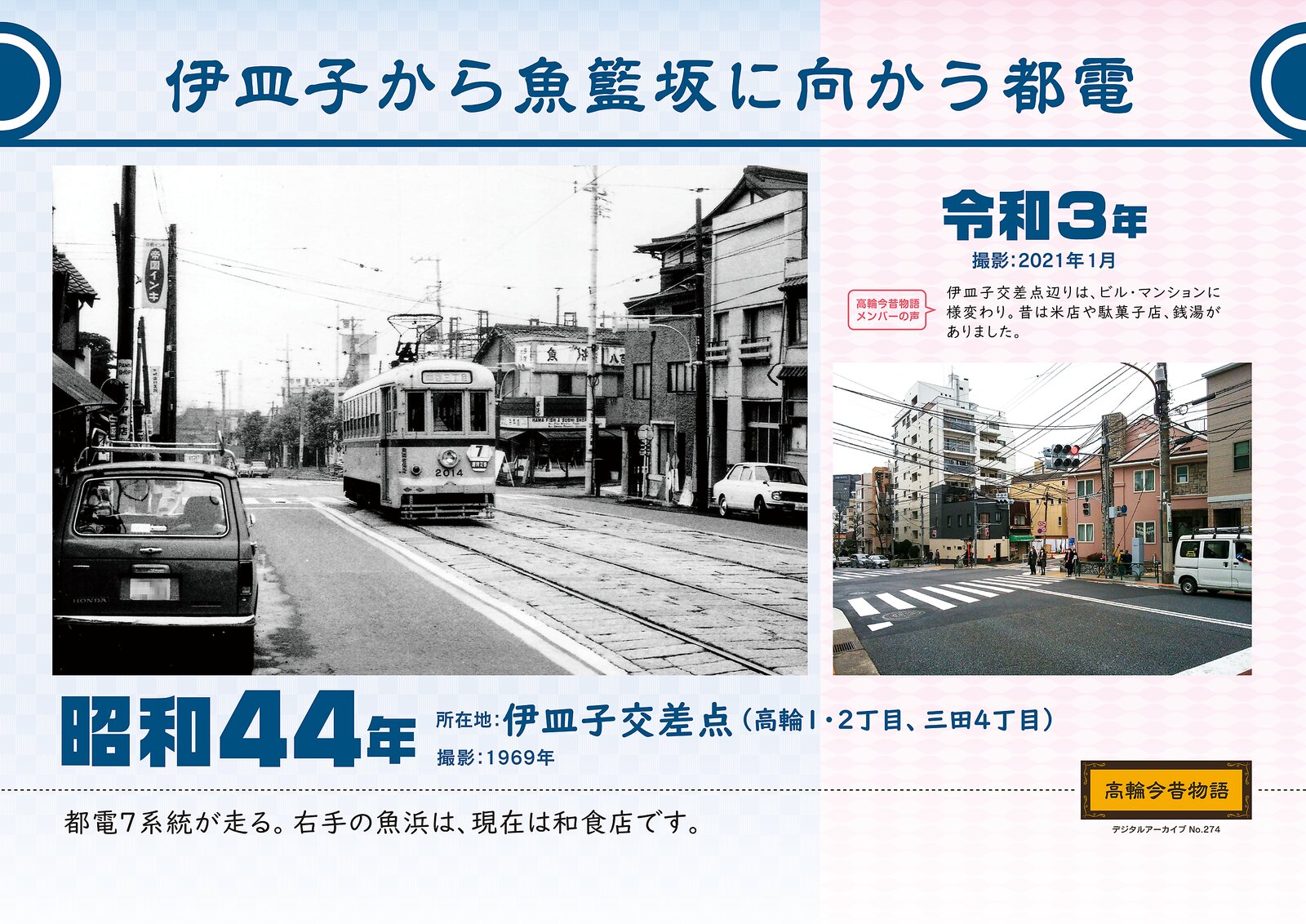
A Toden streetcar and automobiles on National Route 1 (in front of what is now Takanawa Regional City Office). From Seishoko to near Gyoranzaka-shita. This photo was taken from a pedestrian overbridge that no longer exists. There are also not many buildings, and Tokyo Tower is readily visible.
Locations
Seishoko to near Gyoranzaka-shita. (near 1-chome Takanawa / 2-chome Shirokane)
Comment from a member of Takanawa Konjaku Monogatari
We used to have a clear view of Tokyo Tower. Fifty years is a long time.
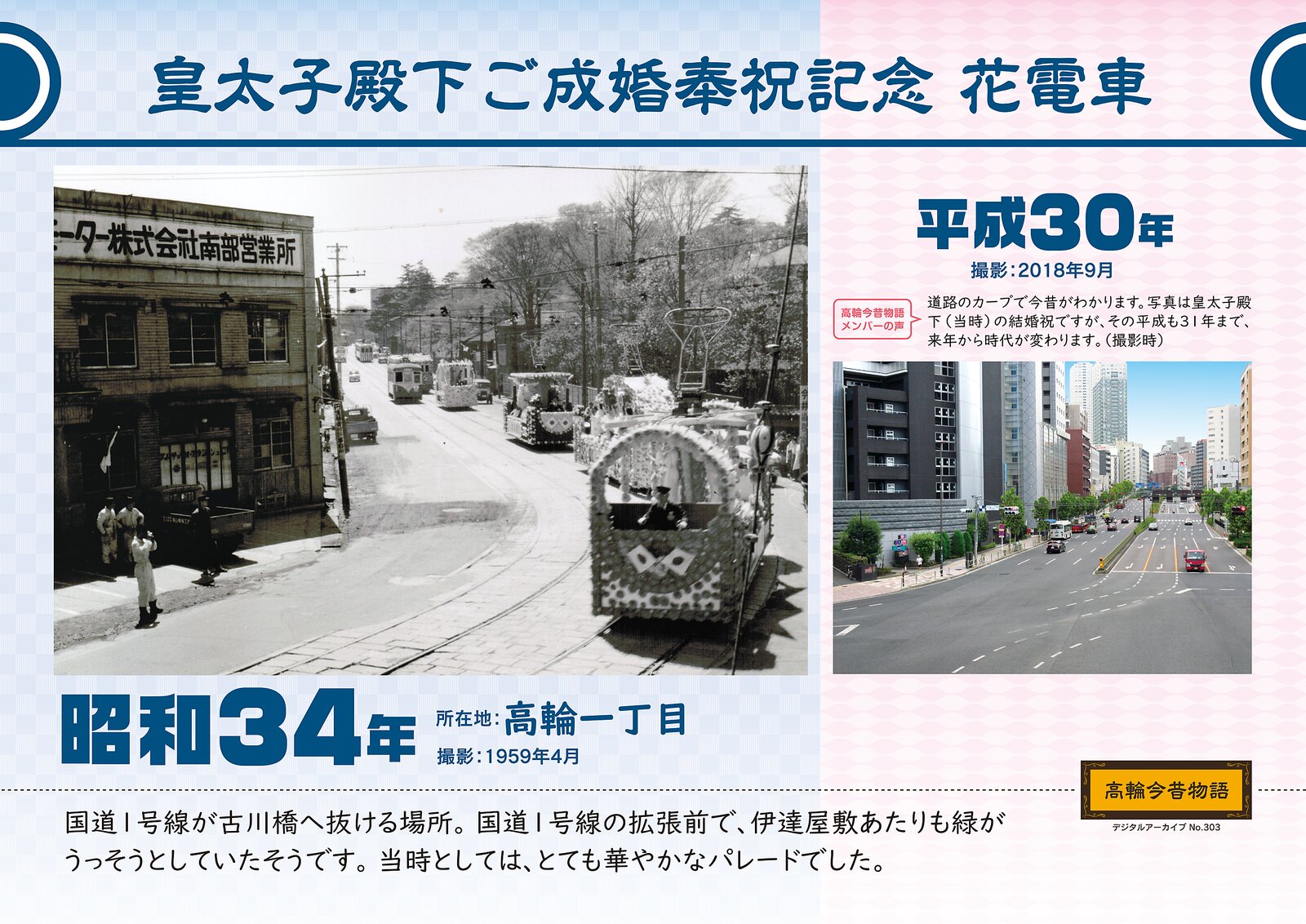
Flower Tram Celebrating the Wedding of His Imperial Highness the Crown Prince.
Produced in FY2018
Photographed in April, 1959 (Showa 34) / September, 2018 (Heisei 30)
It was taken prior to National Route 1 being widened, and there appears to have been lush greenery in the vicinity of the Date residence. At the time it was a very bright and beautiful parade.
Location
1-chome Takanawa
Comment from a member of Takanawa Konjaku Monogatari
You can tell past from present by the curve in the road. The photo is from the wedding celebration of the Crown Prince (at that time). The Heisei era ended at year 31, so the era changes the year after the photo was taken. (At the time of photography)
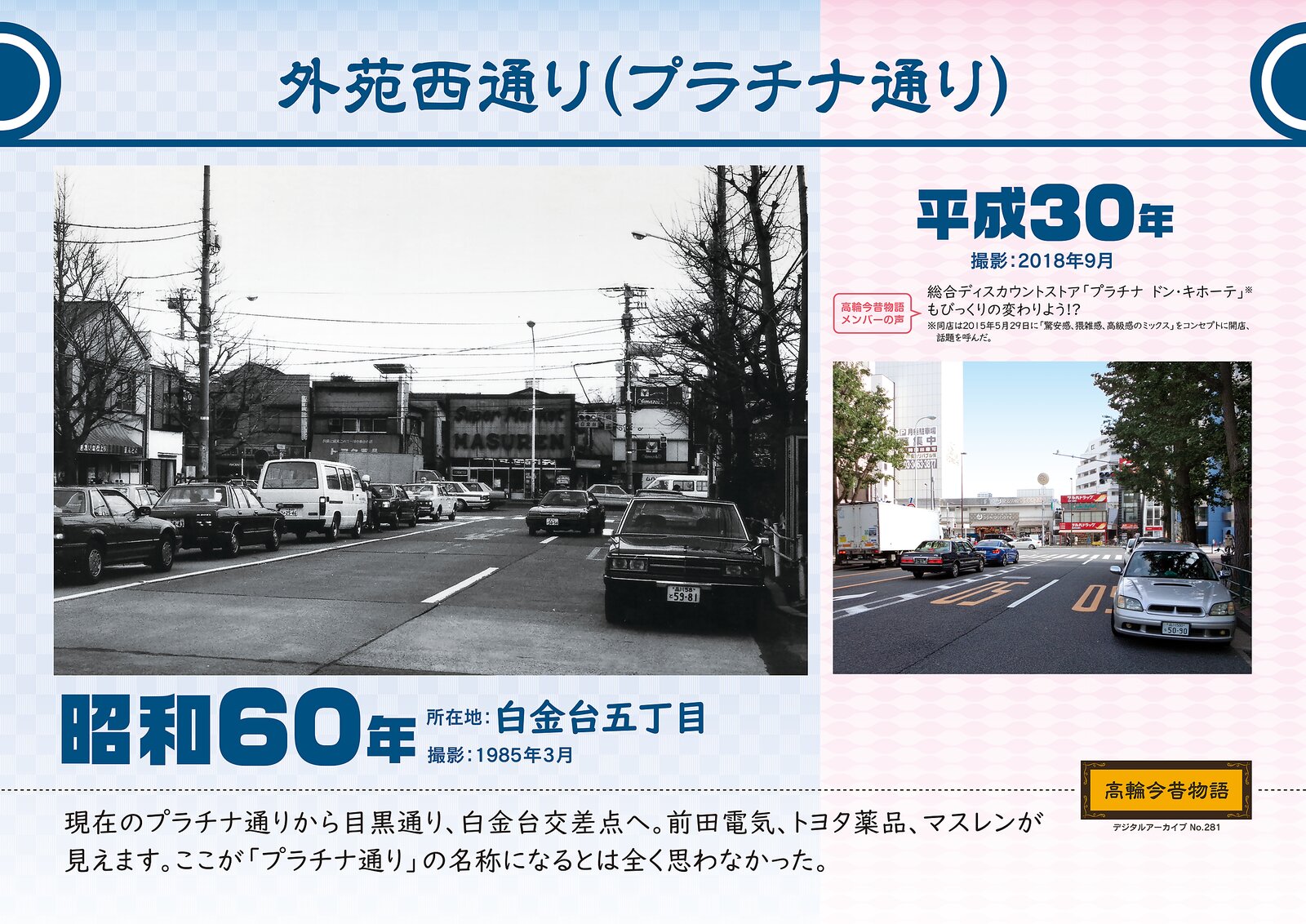
Photographed in March, 1985 (Showa 60) / September 2018, (Heisei 30)
Looking toward Meguro Street and the Shirokanedai intersection from what is now Platinum Street. Maeda Electric, Toyota Pharmaceutical and Masuren are visible. I had no idea whatsoever that this street would become known as Platinum Street.
Location
5-chome Shirokanedai
Comment from a member of Takanawa Konjaku Monogatari
Even the comprehensive discount store “Platinum Don Quijote”* seems to have undergone a surprising transformation!?
*This store opened on May 29, 2015 based on the concept of “a mix of surprising value, chaotic atmosphere, and luxury,” and generated quite a buzz.
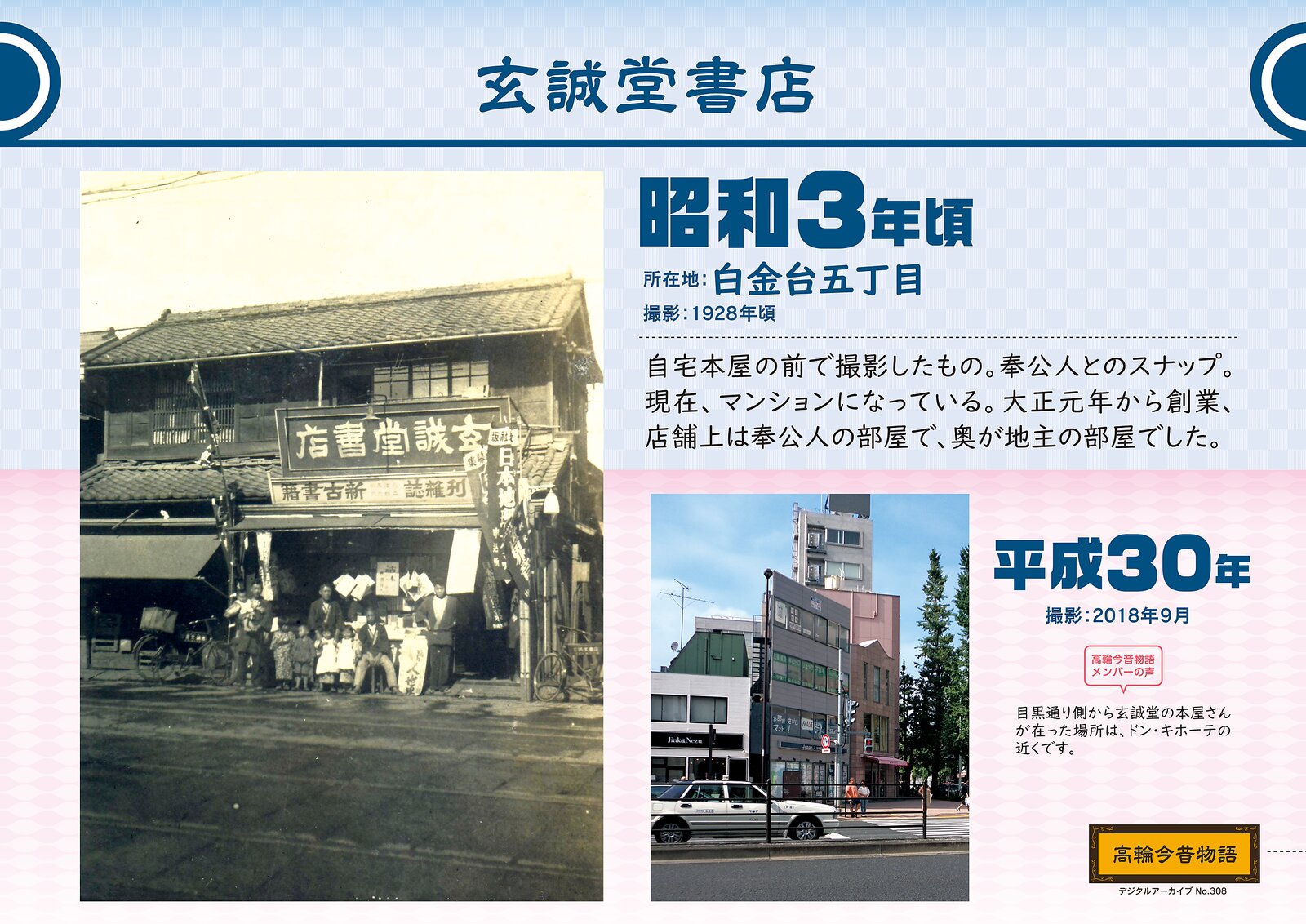
Photographed in 1928 (Showa 3) / September, 2018 (Heisei 30)
Taken in front of our bookstore, with our employees. Today an apartment building stands here. The store began operating in 1912. There were rooms for employees above the store, while the landlord’s rooms were in the interior.
Location
5-chome Shirokanedai
Comment from a member of Takanawa Konjaku Monogatari
The location where Genseido book store stood, viewed from Meguro Street, is near Don Quijote.
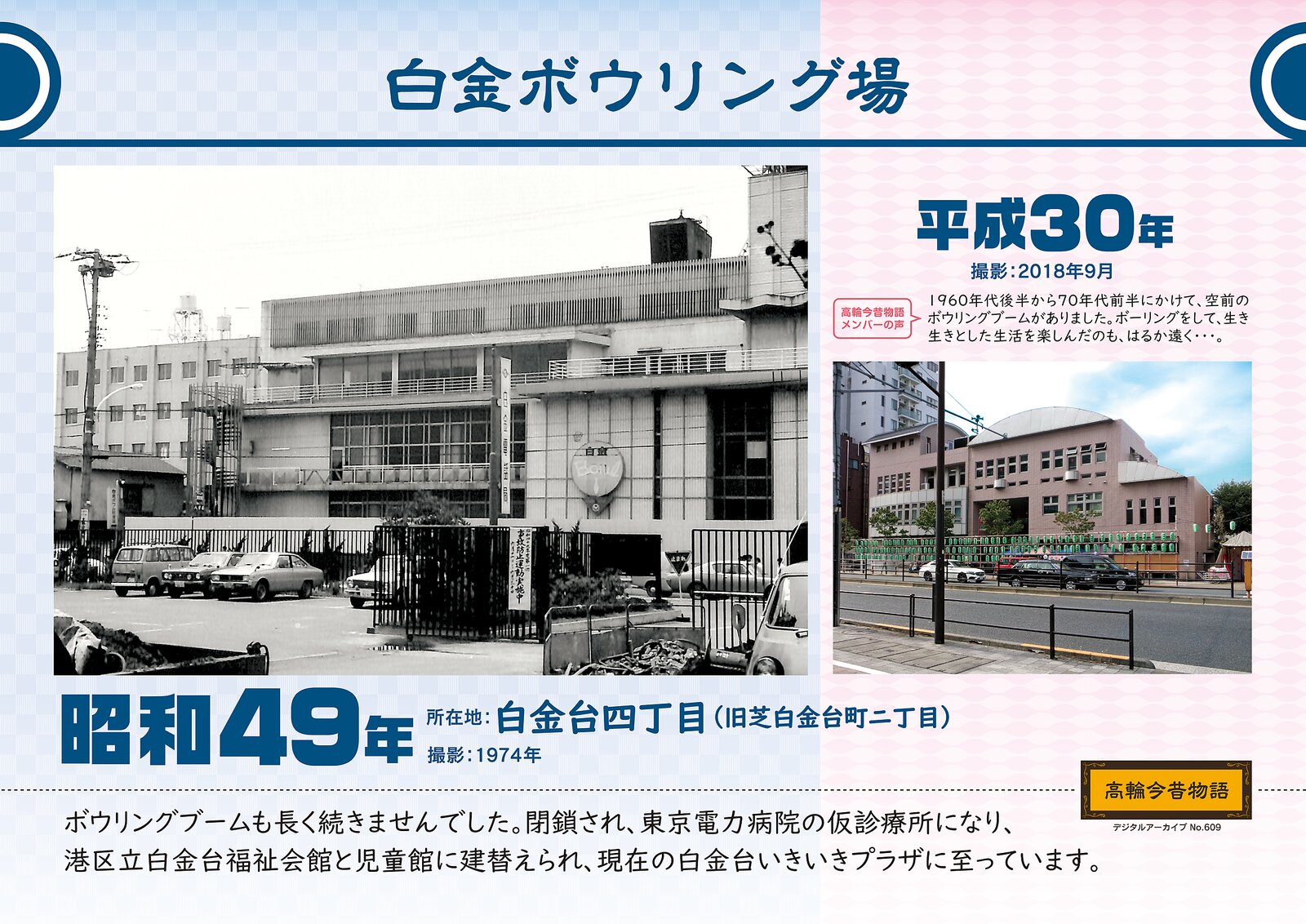
Photographed in 1974 (Showa 49) / September, 2018 (Heisei 30)
The bowling boom did not last long. It was closed, became a temporary clinic for Tokyo Electric Power Hospital, was rebuilt as Minato Municipal Shirokanedai Welfare Center and Children’s Center, and has become the current Shirokanedai Iki-iki Plaza.
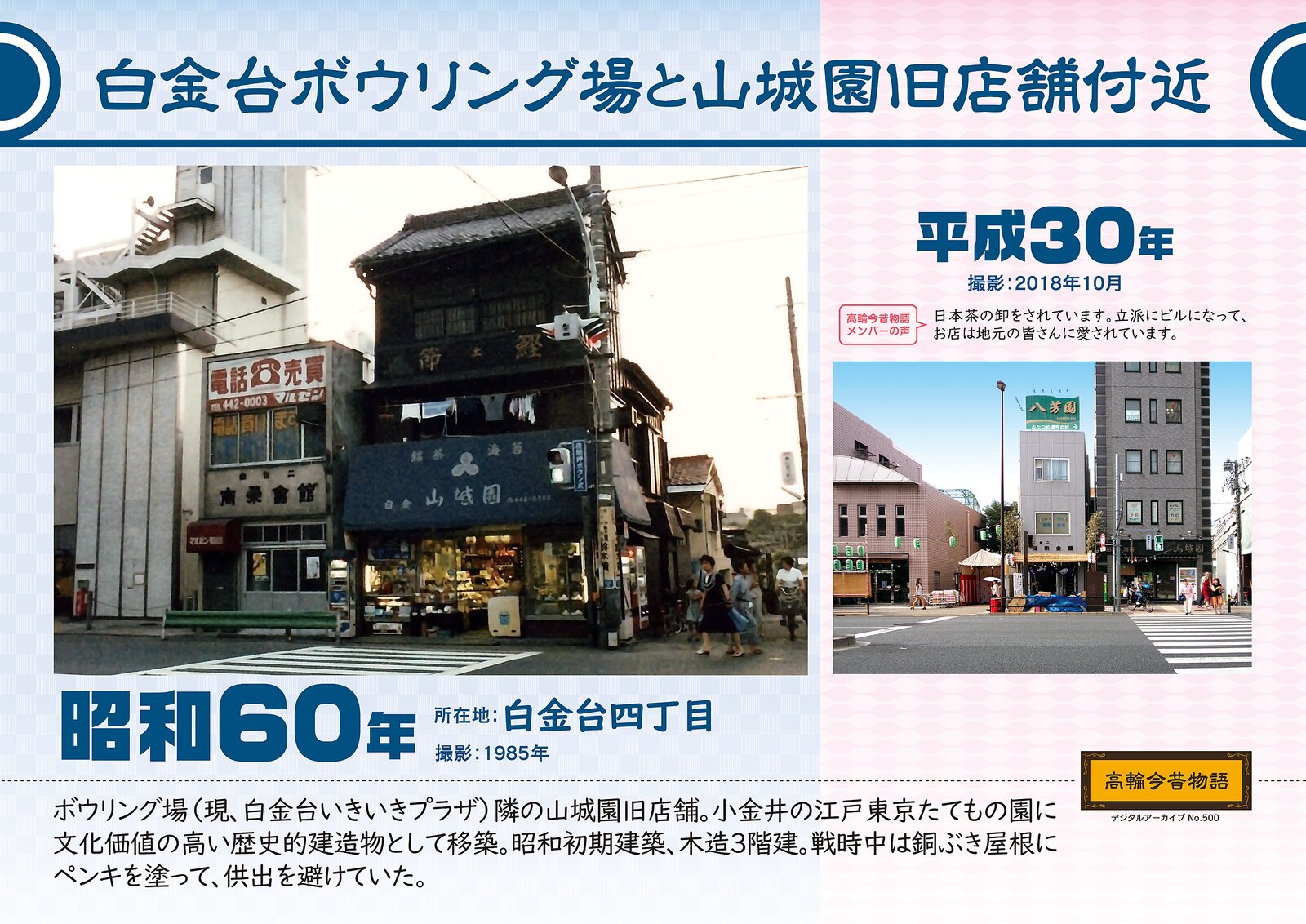
Shirokane Bowling Alley and the vicinity of Yamashiro
Produced in FY2018ed
Photographed in 1985 (Showa 60) / October, 2018 (Heisei 30)
The former Yamashiroen store next to the bowling alley (now the Shirokanedai Iki-Iki Plaza). As a historical building of high cultural value it was dismantled and then reconstructed at Koganei ‘s Edo-Tokyo Open Air Architectural Museum. It is a three-story wooden building of the early Showa architectural style. During the War, the copper-shingled roof was painted to avoid it having to be obligatorily supplied to the government.
Location
4-chome Shirokanedai
Comment from a member of Takanawa Konjaku Monogatari
This is a wholesale retailer of Japanese tea. The building has become impressive, and the store is loved by local residents.
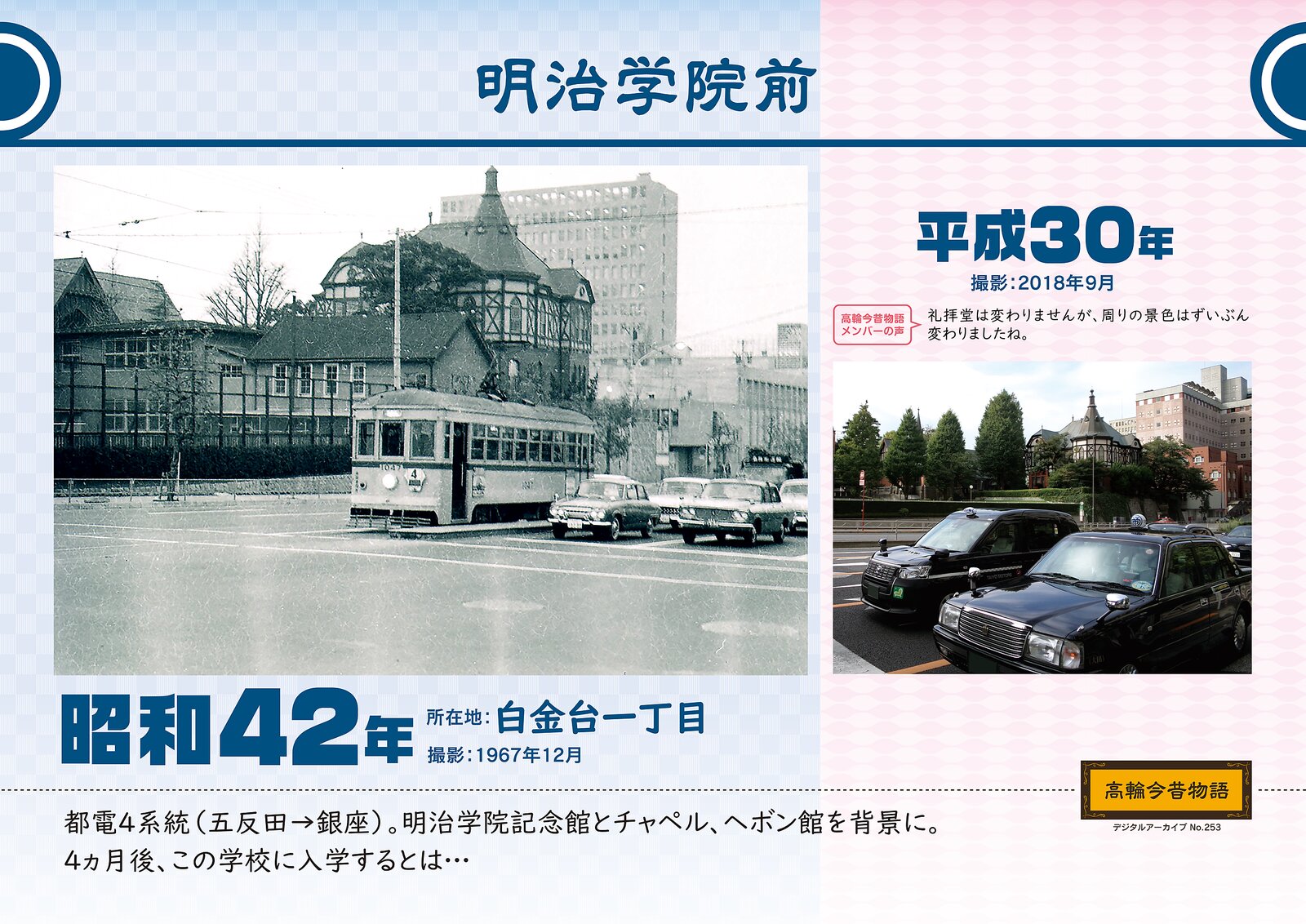
Photographed in Showa 42(December 1967) / Heisei 30 (October 2018)
A Toden Line 4 streetcar (Gotanda to Ginza). Meiji Gakuin’s Memorial Hall, chapel, and Hepburn Building are in the background. I was to enter this university four months later…
Location
1-chome Shirokanedai
Comment from a member of Takanawa Konjaku Monogatari
The chapel hasn’t changed, but the surrounding scenery has changed considerably.
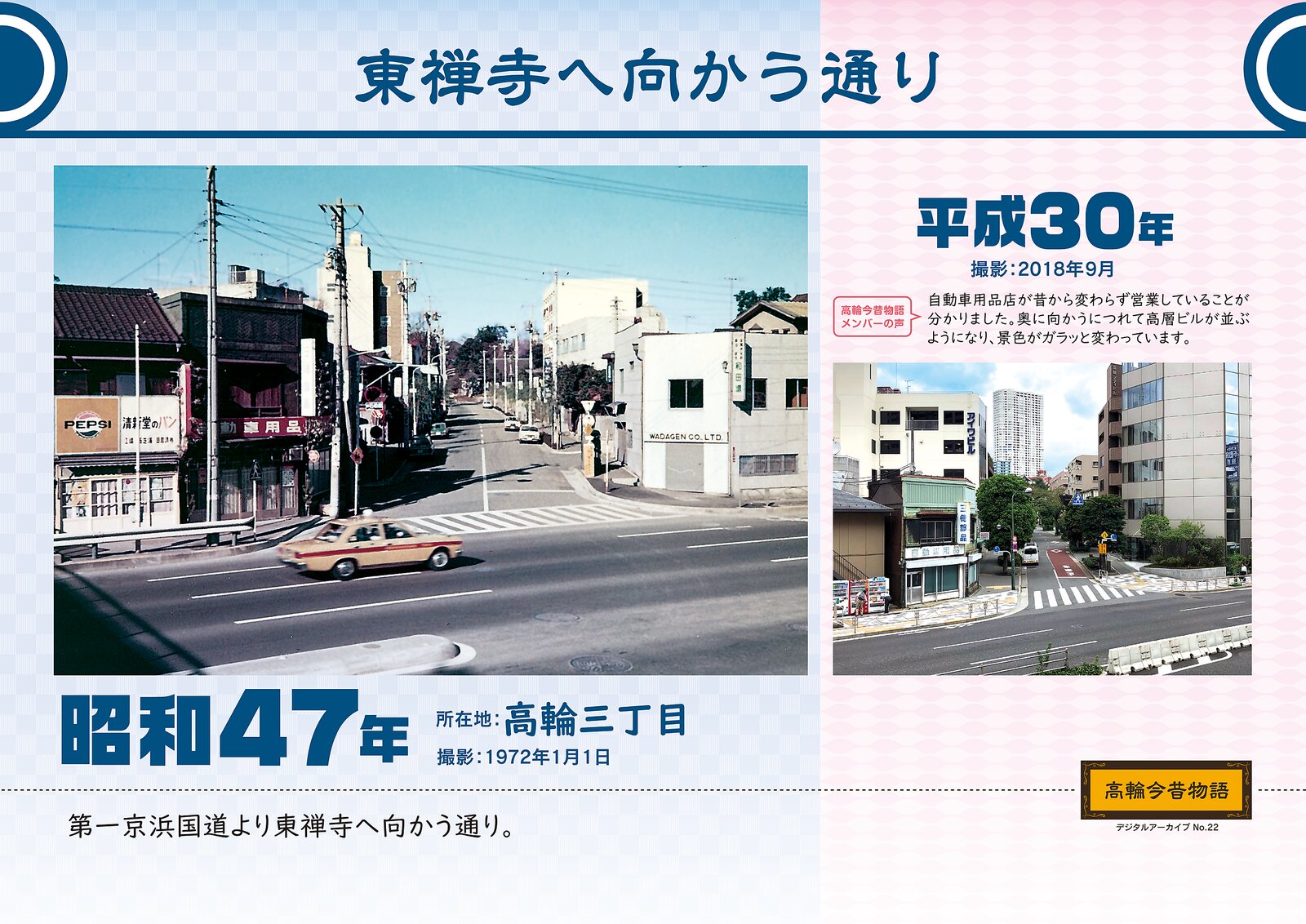
Photographed in January 1st, 1972 (Showa 47) / September, 2018 (Heisei 30)
A street that leads to Tozenji from Dai-ichi Keihin Kokudo.
Location
3-chome Takanawa
Comment from a member of Takanawa Konjaku Monogatari
We discovered that the auto parts store has continued operating unchanged since the past. As you head further in, high-rise buildings now line the street and the scenery has changed completely.
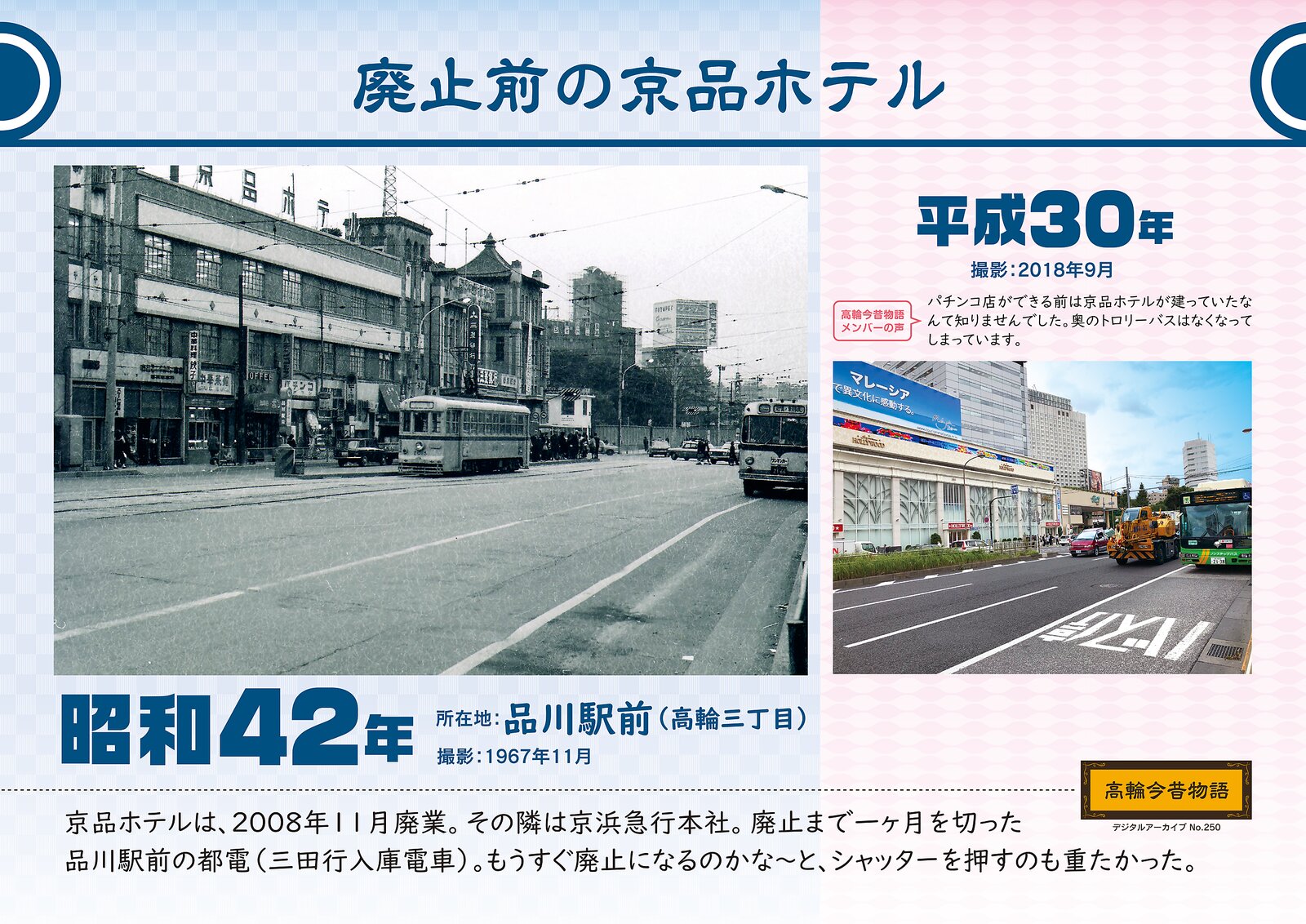
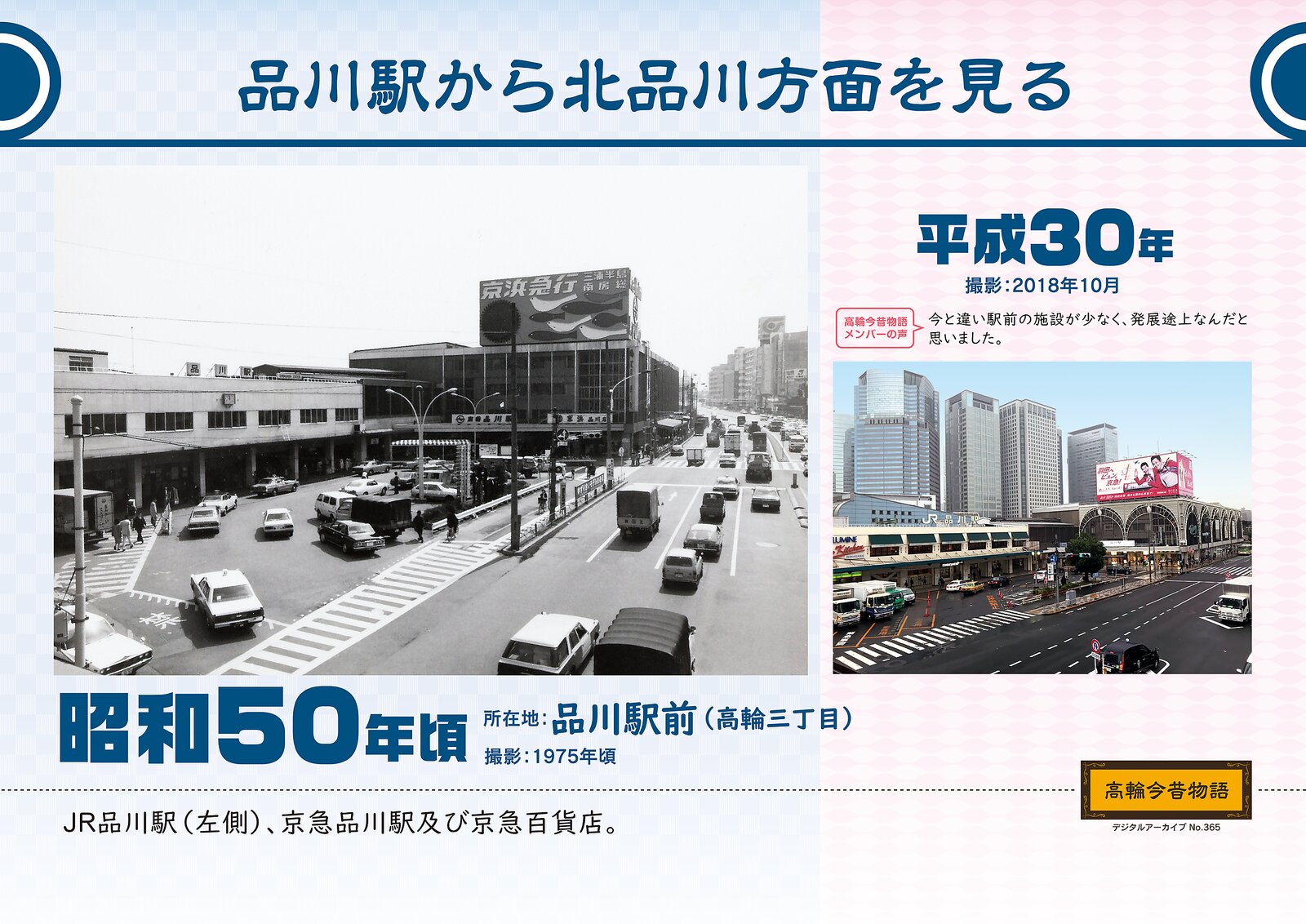
Keihin Hotel closed in November 2008. The building next to it is the Head Office of Keikyu Corporation. A Toden streetcar was stopped in front of Shinagawa Station (bound for the Mita depot), with less than a month remaining before the line was discontinued. I pressed the camera shutter with a heavy heart knowing the streetcar would very soon stop running.
Location
In front of Shinagawa Station, 3-chome Takanawa
Comment from a member of Takanawa Konjaku Monogatari
I didn’t know that Keihin Hotel stood there before the pachinko parlor was built. The trolley bus in the back is now gone.
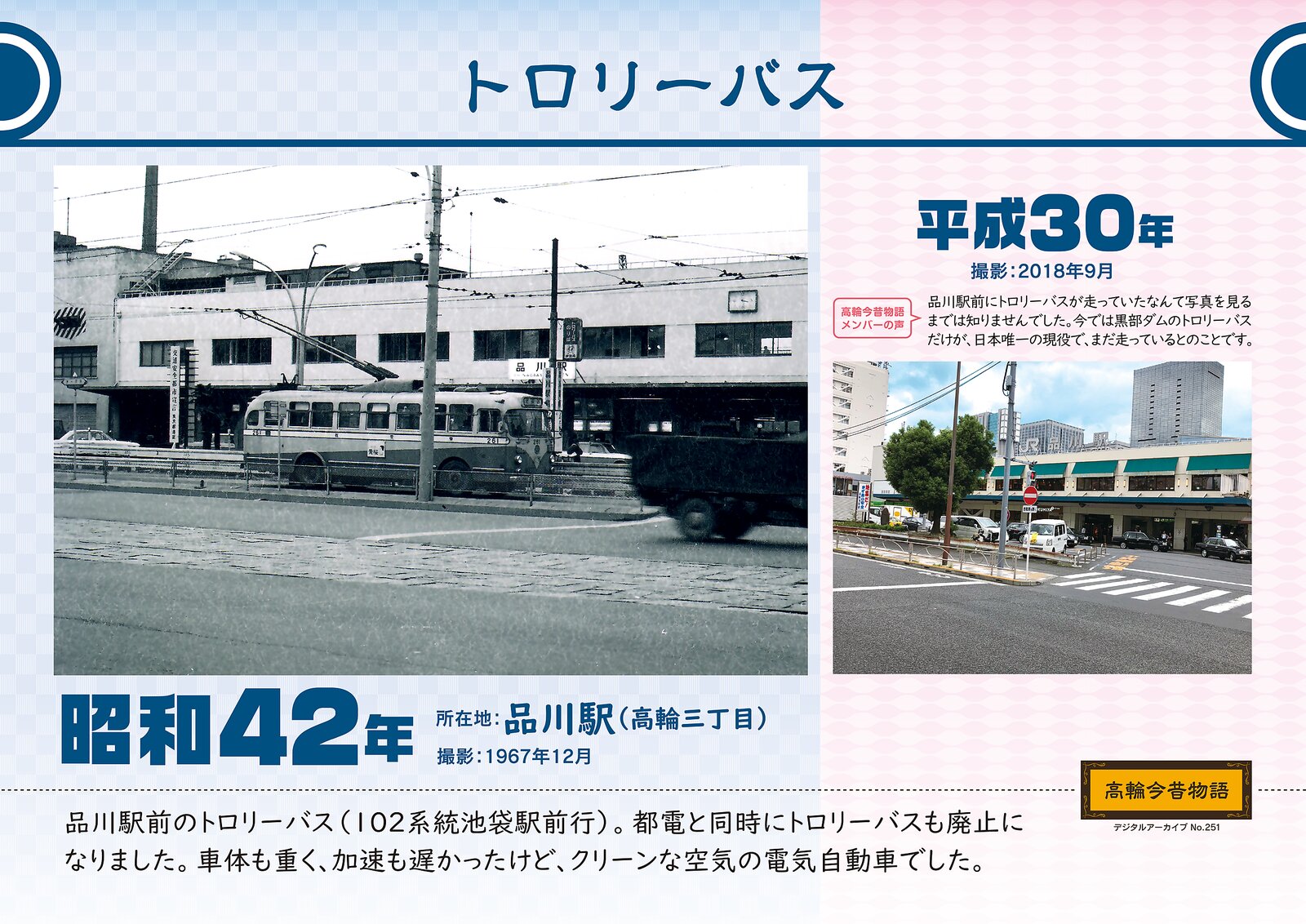
A trolley bus in front of Shinagawa Station (Line 102 bound for the front of Ikebukuro Station). Trolley buses were discontinued at the same time as Toden was. The buses were heavy-bodied and were slow to pick up speed, but they were clean air, electric vehicles.
Location
Shinagawa Station, 3-chome Takanawa
Comment from a member of Takanawa Konjaku Monogatari
I didn’t know until I saw the photo that trolley buses ran in front of Shinagawa Station. Now, the Kurobe Dam trolley bus is the only one still operating in Japan.
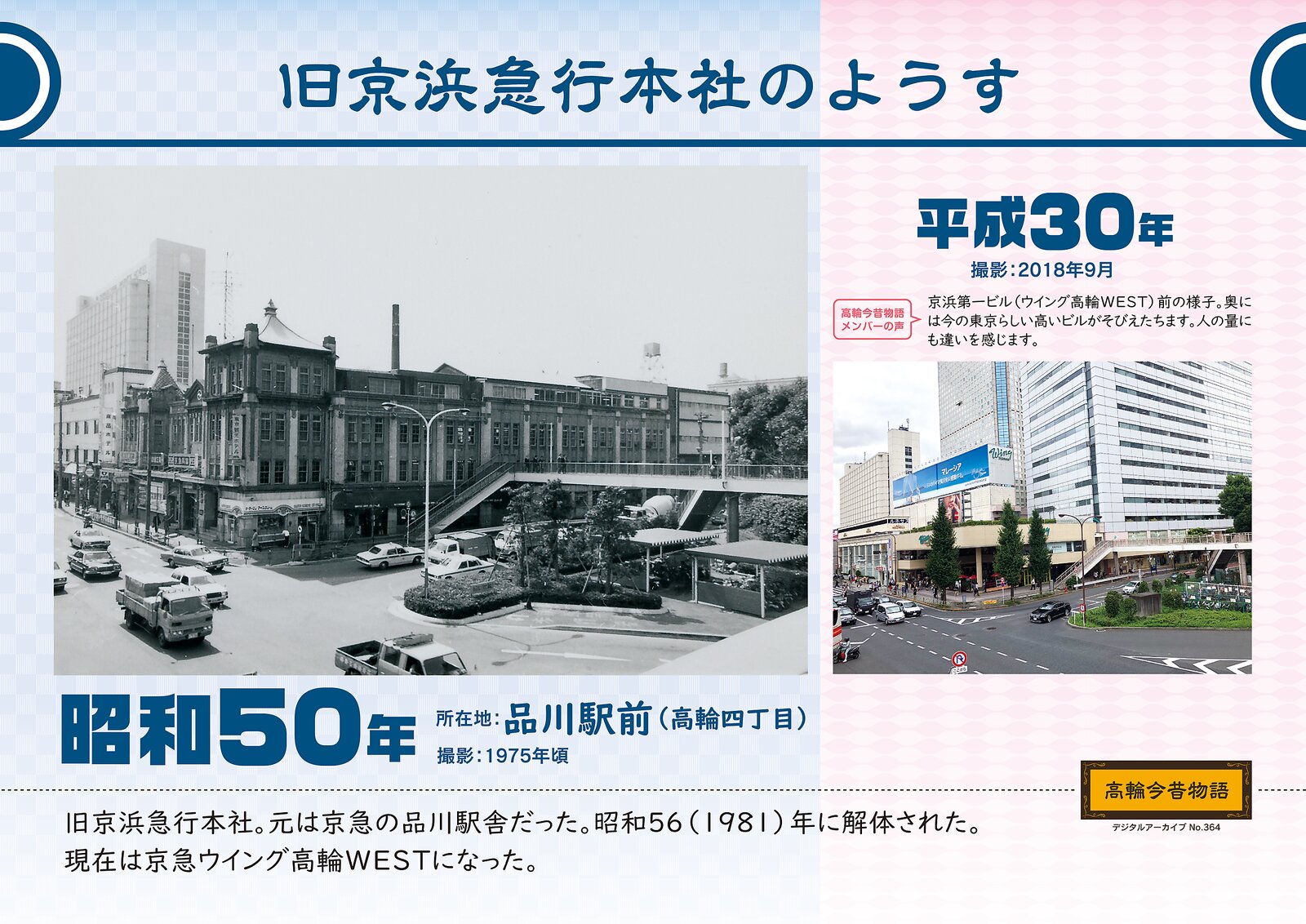
Photographed in around 1975 (Showa 50) / September, 2018 (Heisei 30)
Keikyu Corporation Head Office. Originally it was Keikyu’s Shinagawa Station building. It was demolished in 1981 (Showa 56). Currently it is Keikyu Wing Takanawa.
Location
In front of Shinagawa Station, 4-chome Takanawa
Comment from a member of Takanawa Konjaku Monogatari
The scene in front of Keihin Daiichi Building (Wing TAKANAWA WEST). In the back, there are tall, towering buildings characteristic of modern Tokyo. You can feel the difference in the number of people too.
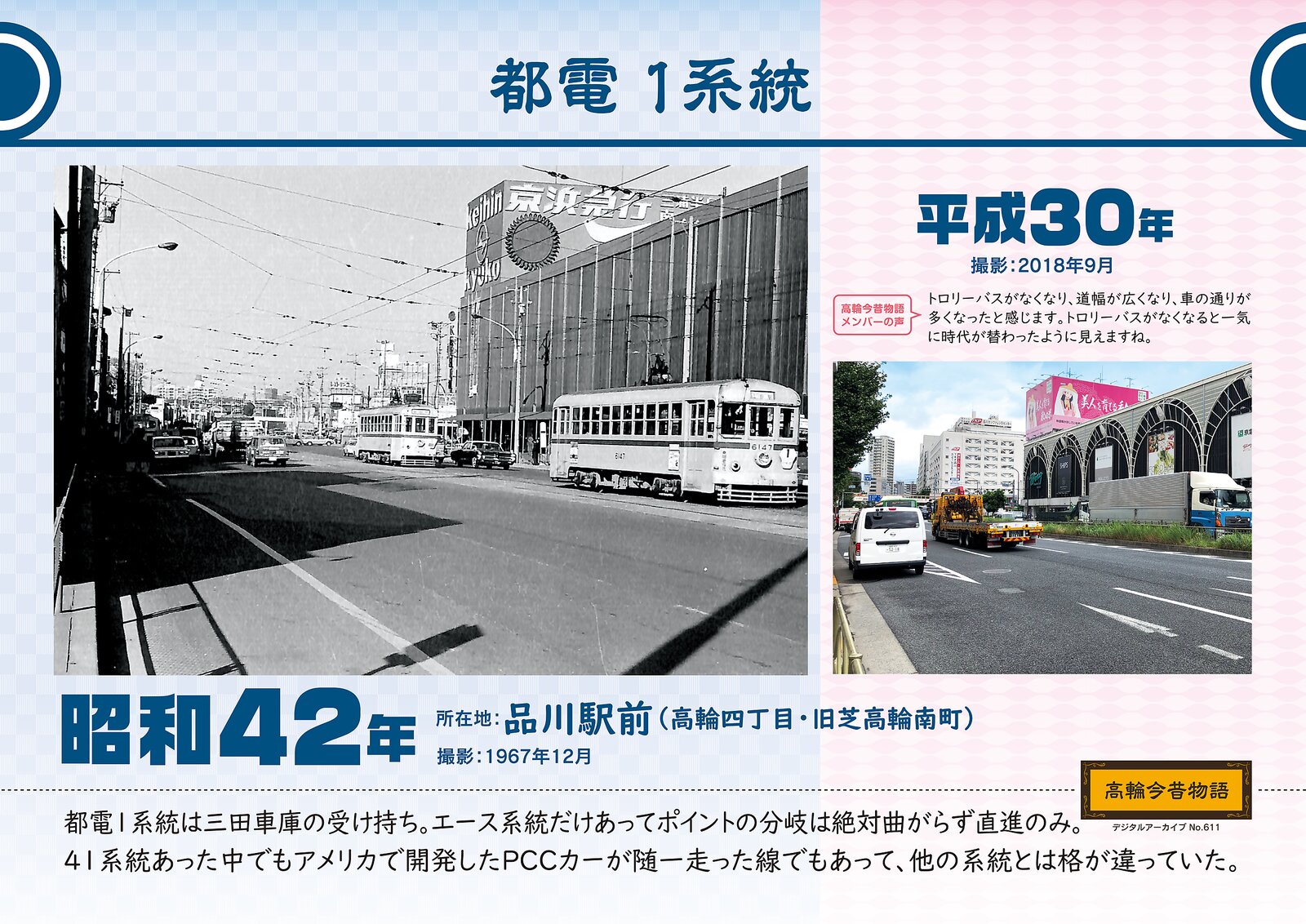
Toden Line 1 was operated by Mita Depot. As the “ace route” (priority route), it never turned at branching points but only traveled in a straight line. Among the 41 lines, this was where the PCC cars developed in America ran most frequently, setting it apart from other lines.
Location
In front of Shinagawa Station, 4-chome Takanawa (former Shiba-Takanawa minami-cho)
Comment from a member of Takanawa Konjaku Monogatari
The trolley bus has disappeared, the road is wider, and I feel there’s more vehicular traffic. When the trolley bus disappeared, it felt as if the era changed all at once.
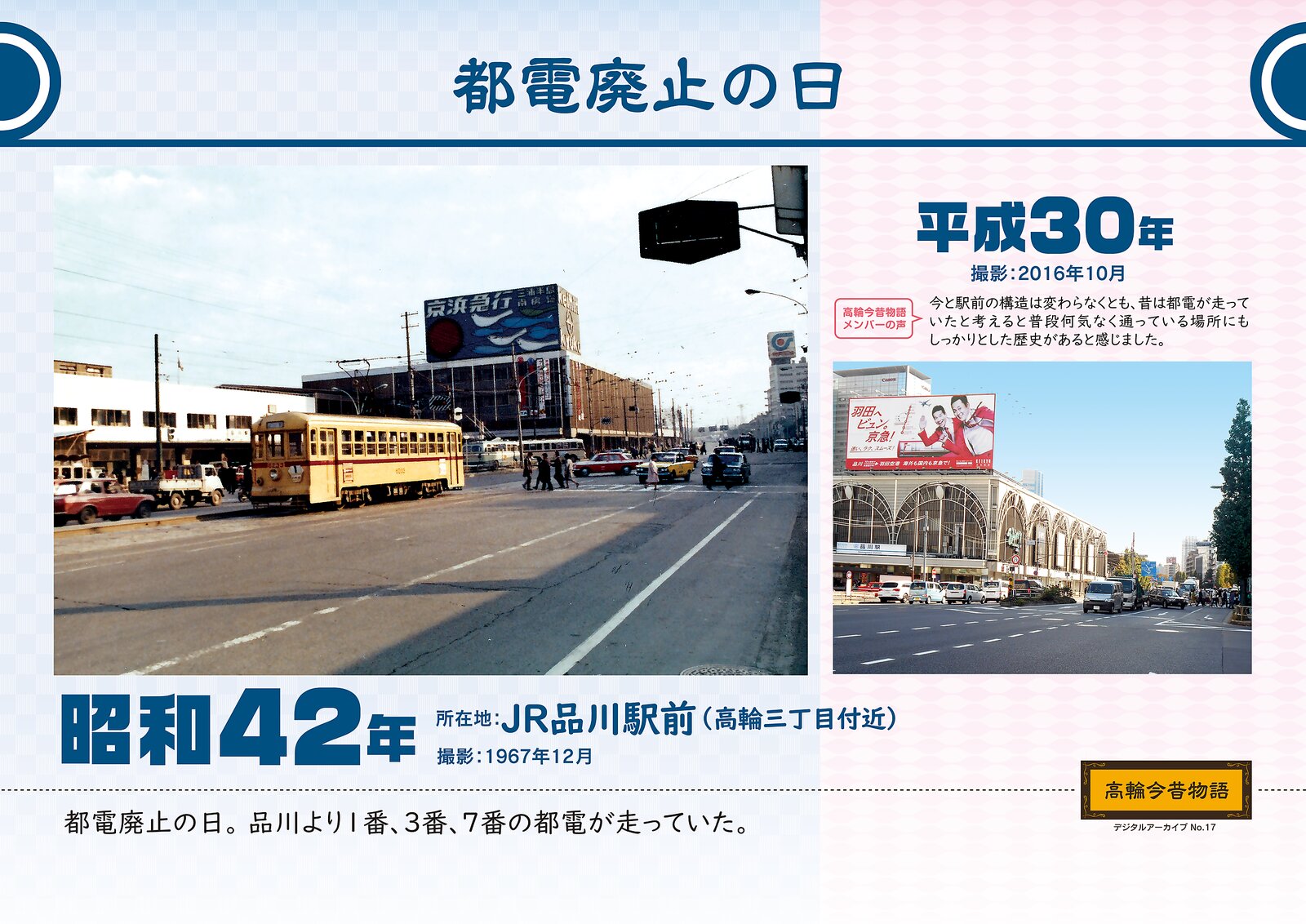
The day Toden was discontinued. Streetcar No. 1, 3, and 7 had been running from Shinagawa.
Location
In front of JR Shinagawa Station (Around 3-chome Takanawa)
Comment from a member of Takanawa Konjaku Monogatari
Even though the structure in front of the station looks the same as it is today, when you think that Toden used to run here, you feel that even places you pass by casually have a rich history.
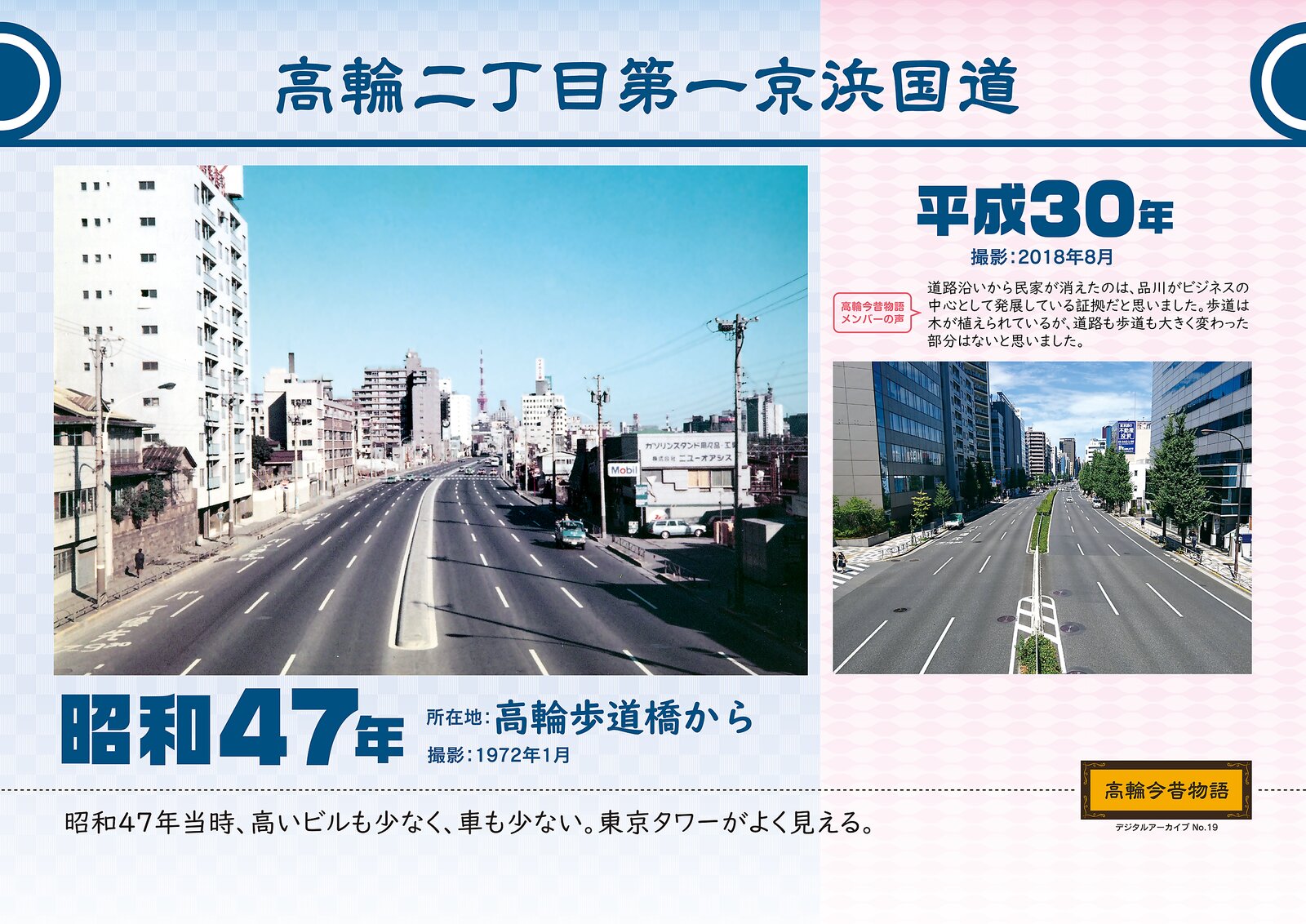
At this time, in 1972, there were few tall buildings and not many cars either. Tokyo Tower can be easily made out.
Location
From the Takanawa Footbridge
Comment from a member of Takanawa Konjaku Monogatari
I felt that the disappearance of private homes along the road is evidence that Shinagawa has developed primarily as a business center. Trees are planted along the sidewalk, but I didn’t think the road or sidewalk have changed much.
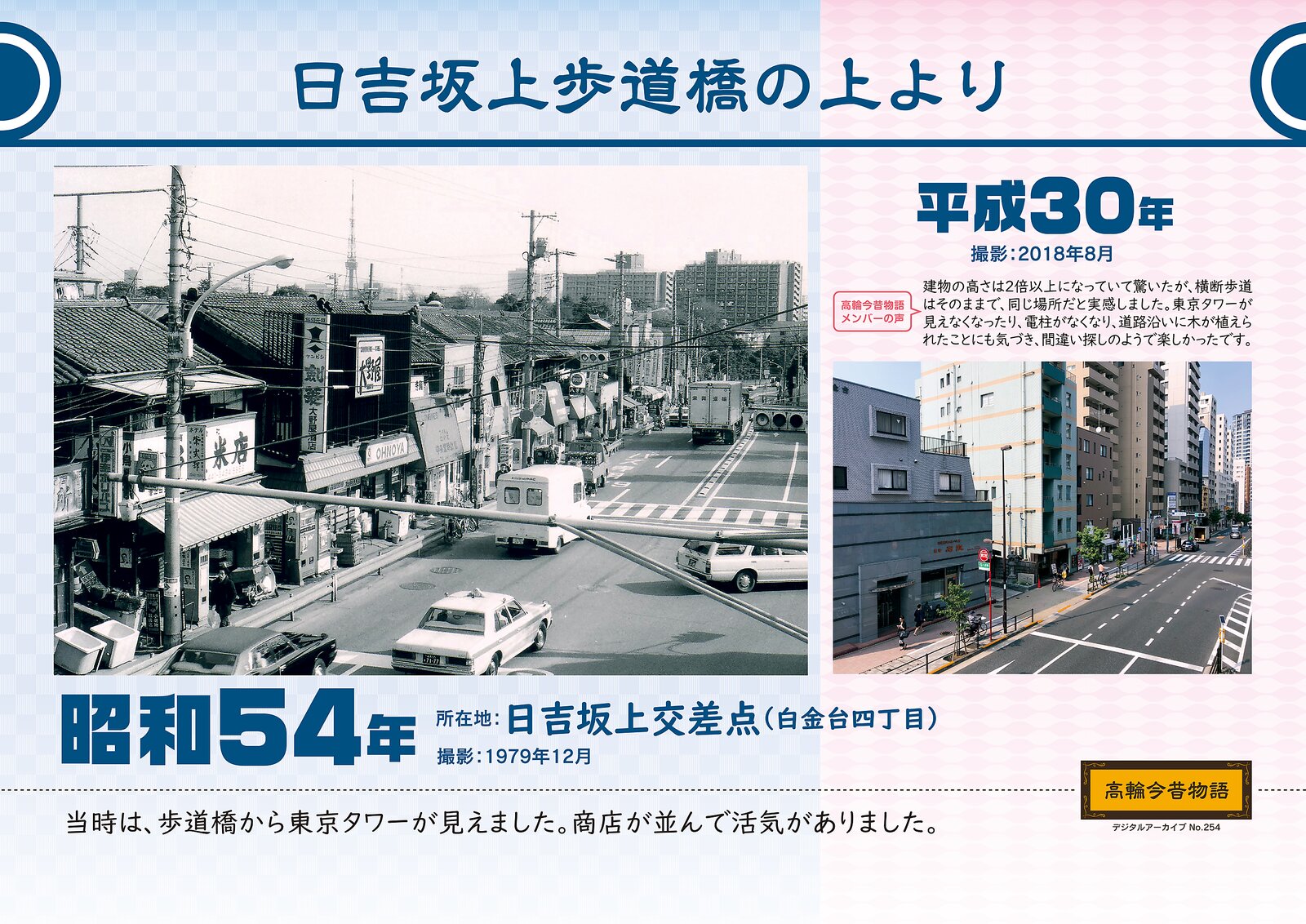
At the time, you could see Tokyo Tower from the pedestrian overbridge. With its line of stores, the area was lively.
Location
Hiyosizakaue intersection (4-chome Shirokanedai)
Comment from a member of Takanawa Konjaku Monogatari
I was surprised that the building height has more than doubled, but the crosswalk has remained the same, giving me a strong sense that it is still the same place. I noticed that Tokyo Tower can no longer be seen from here, utility poles have disappeared, and trees have been planted along the road—it was fun looking for the differences.
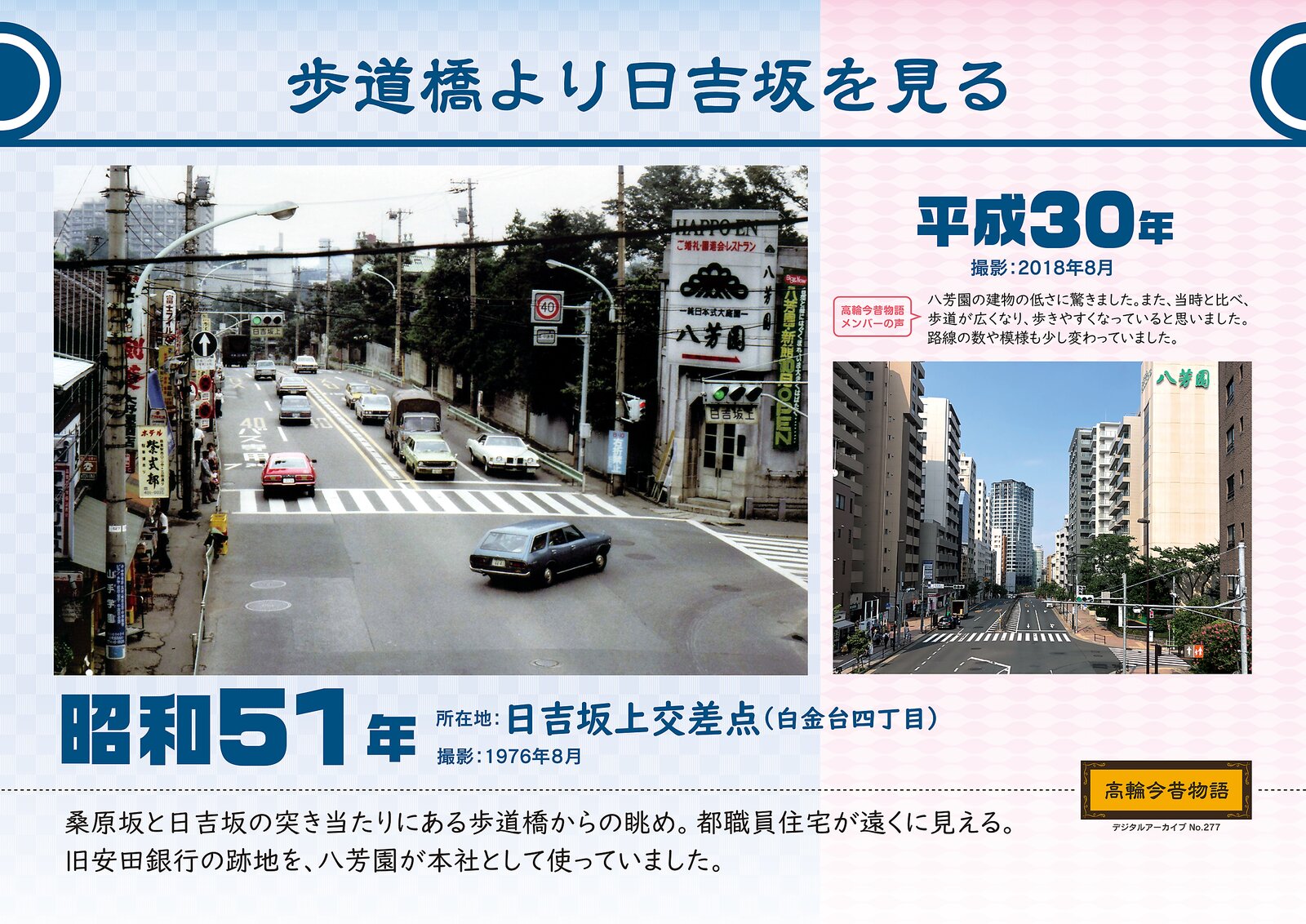
Looking from the pedestrian overbridge at the end of Kuwabarazaka and Hiyoshizaka. A city employee housing complex can be seen in the distance. Happo-en was using the former Yasuda Bank site as its headquarters.
Location
Hiyosizakaue intersection (4-chome Shirokanedai)
Comment from a member of Takanawa Konjaku Monogatari
I was surprised by how low the Happoen building was. Also, compared to back then, the sidewalk has become wider and I think it’s easier to walk on. The number of lanes on the road and their patterns have also changed a little.
Comment from a member of Takanawa Konjaku Monogatari
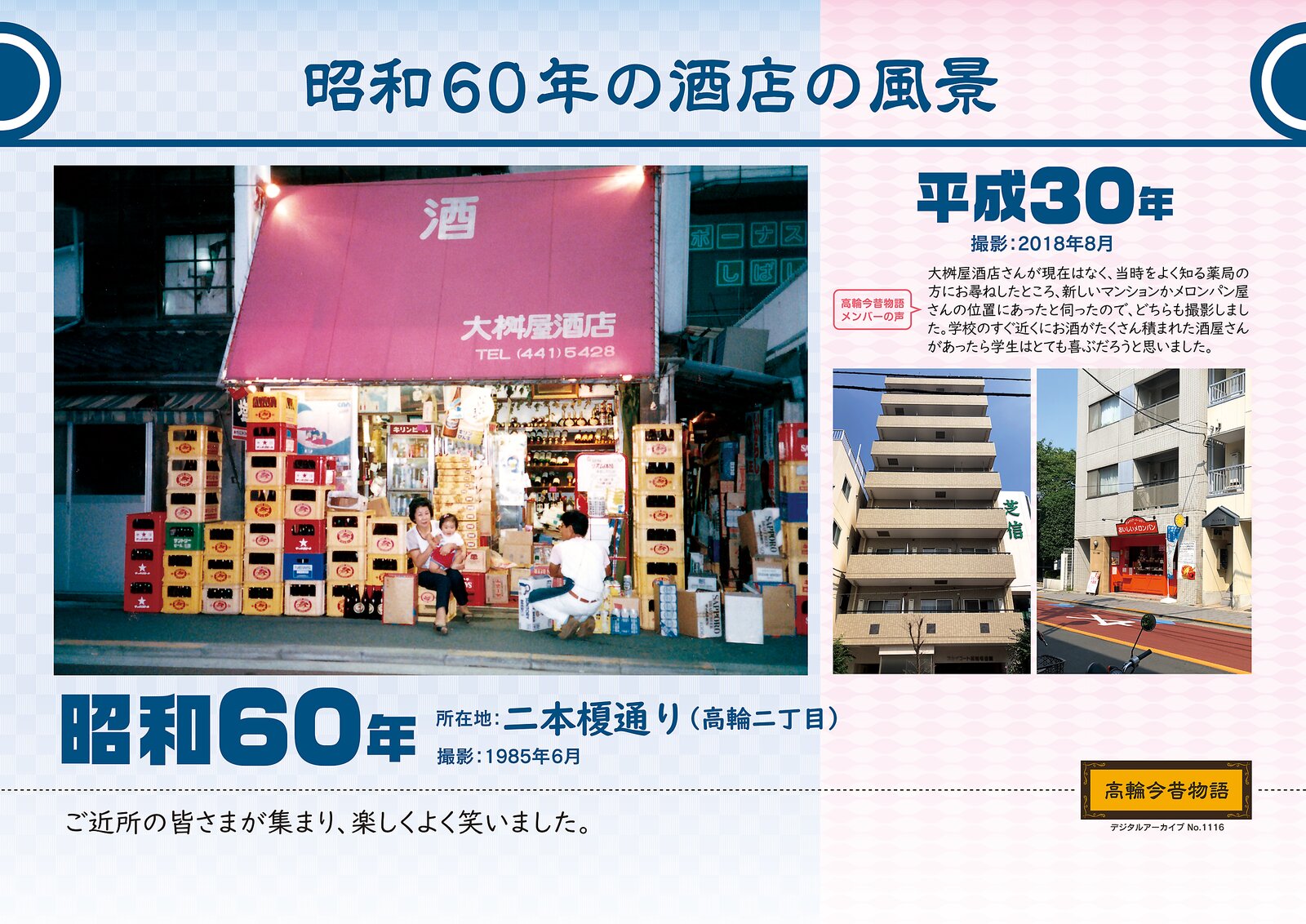
Omasuya liquor store no longer exists, and when we asked a pharmacist who knows the area well, they said it had been located either where the new apartment building or the melon bread shop stand, so we photographed both. I thought students would be very happy if there were a liquor store with a lot of sake piled up right near school.
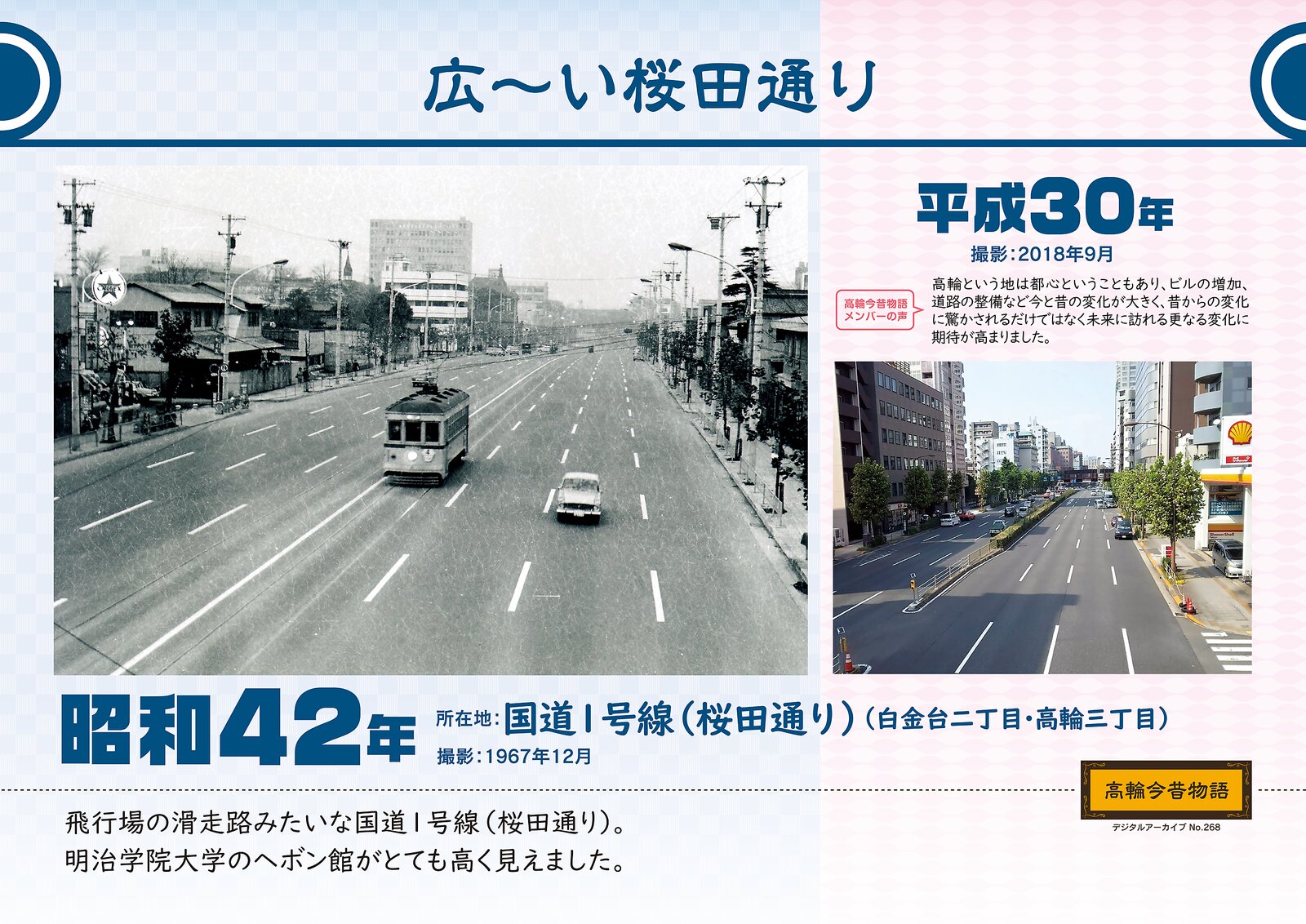
National Route 1 (Sakurada Street) resembles an airport runway. Meiji Gakuin University’s Hepburn Building seems very tall.
Comment from a member of Takanawa Konjaku Monogatari
Since Takanawa is in the city center, the changes from past to present are significant, such as more buildings and road development. I’m not only surprised by changes from the past, but I also have growing expectations for further changes that will come in the future.
Location
National Route 1 (Sakurada Street) (2-chome Shirokanedai / 3-chome Takanawa)
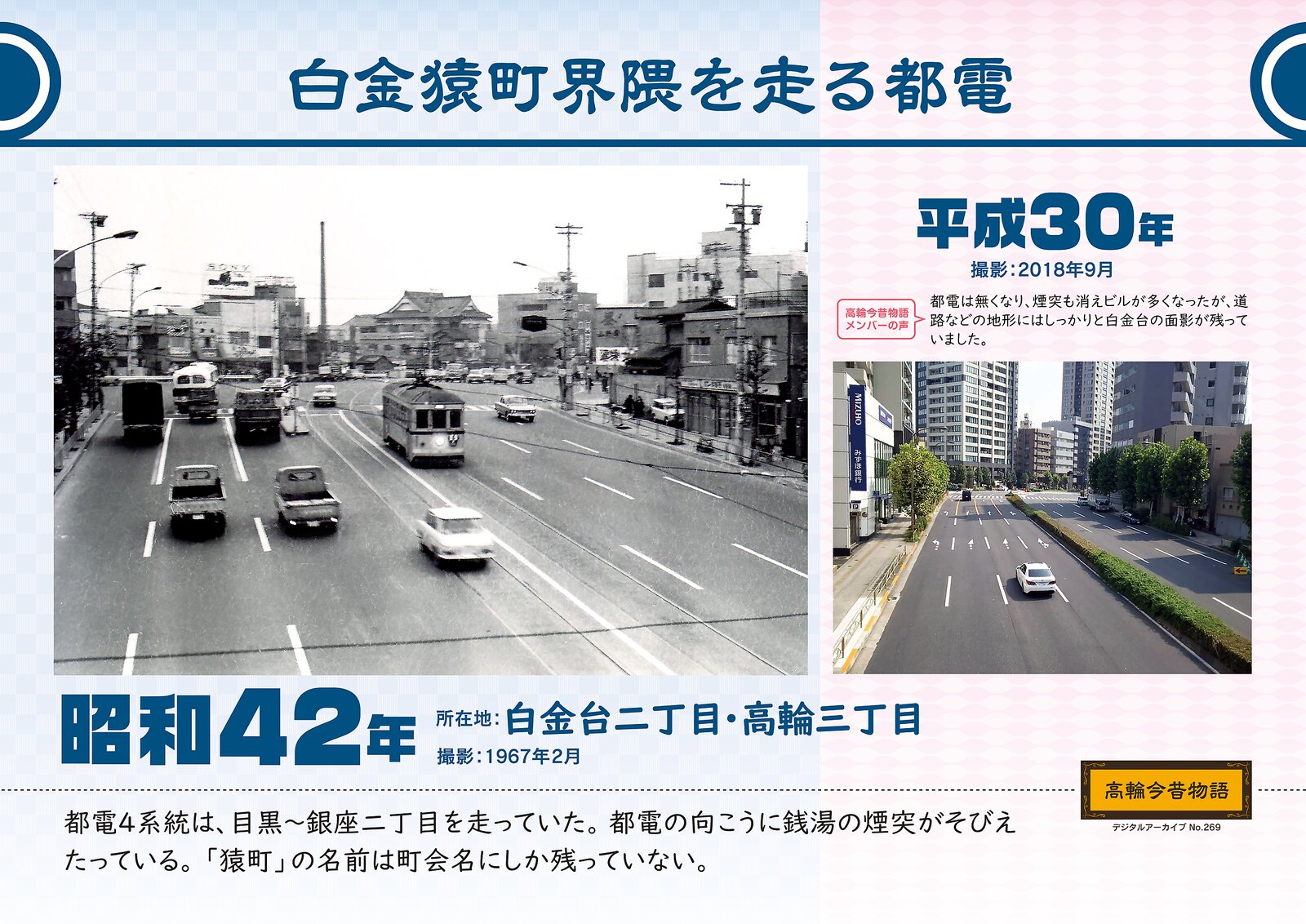
The Toden Line 4 ran between Meguro and Ginza 2-chome. Beyond the Toden streetcar towers a chimney from a public bathhouse. The name “Sakuramachi” only remains in the form of a town association’s name.
Location
2-chome Shirokanedai / 3-chome Takanawa
Comment from a member of Takanawa Konjaku Monogatari
Toden is gone, the chimneys have disappeared, and there are more buildings, but traces of Shirokanedai remain clearly in the terrain of the roads.
Comment from a member of Takanawa Konjaku Monogatari
With low-roofed buildings, an imperial visit, and streetcars—scenery that is completely different from now—I got a strong sense of the changes in Shirokanedai from the past to the present.
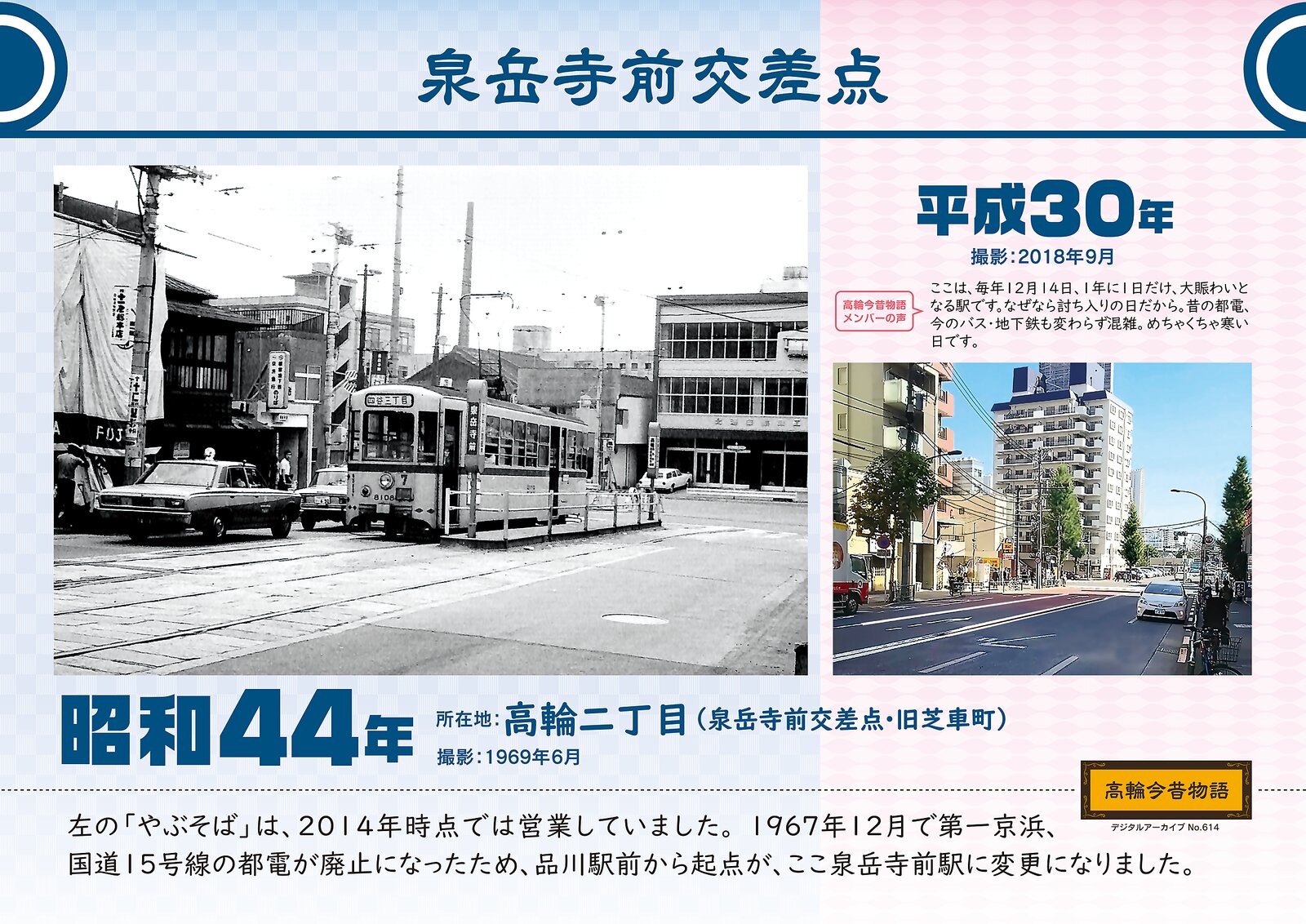
The “Yabu Soba” eatery on the left is still operating in the same building today. In December 1967, the Toden service on National Route 15 (Dai-ichi Keihin) was discontinued, so the starting point was moved from the front of Shinagawa Station to here, at Sengakuji Station.
Comment from a member of Takanawa Konjaku Monogatari
This is a station that becomes crowded only one day every year, on December 14, because it’s the day of the raid, an incident related to the forty-seven ronin. The former Toden, as well as the buses and subways of today, are both crowded. It’s an extremely cold day.
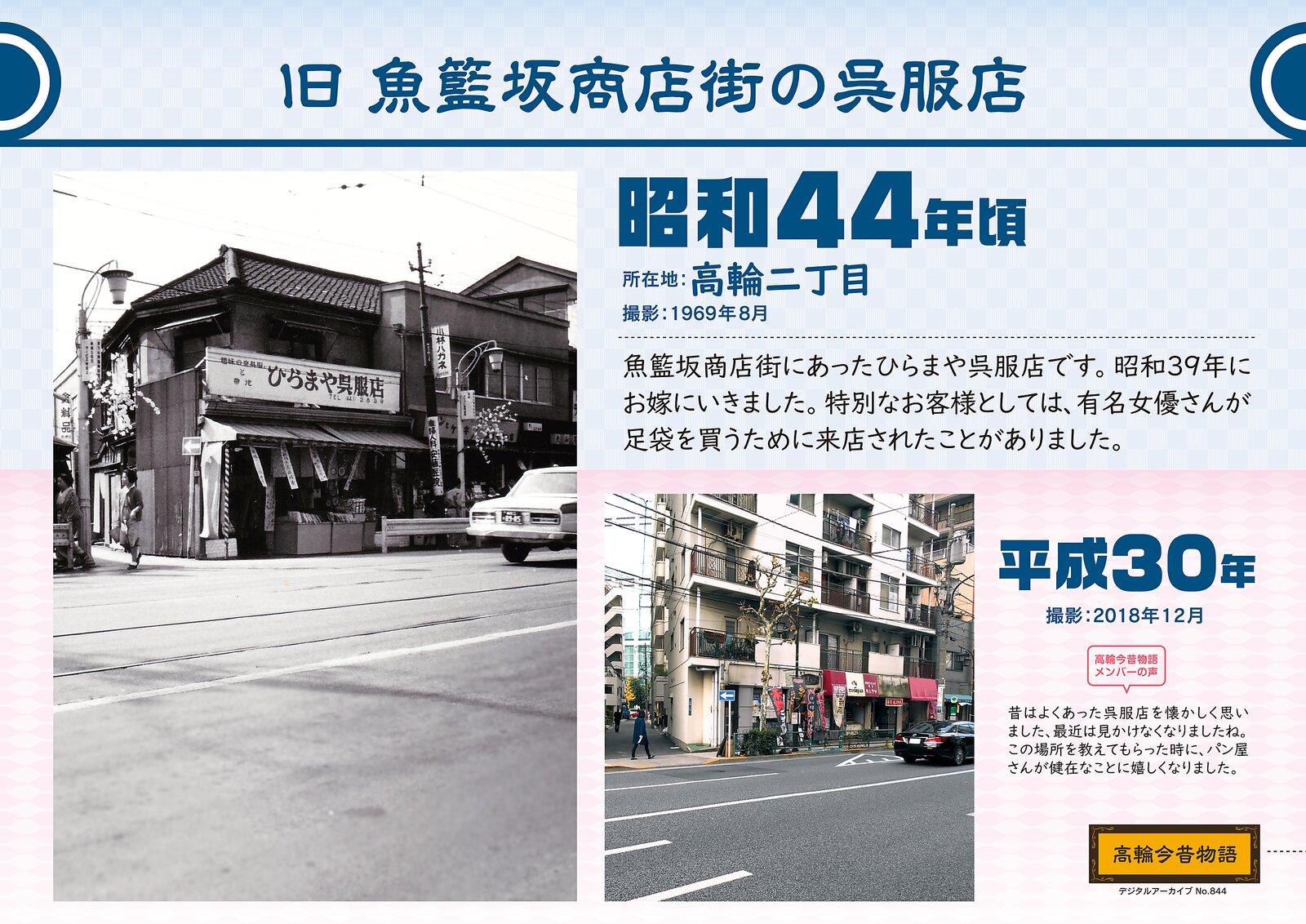
Photographed in around August, 1969 (Showa 44) / December, 2018 (Heisei 30)
This is Hiramaya Kimono Store (our home) that was on Gyoranzaka shopping street. I got married in 1964. The actress Sayuri Yoshinaga, a special customer, once came to the store to buy tabi.
Location
2-chome Takanawa
Comment from a member of Takanawa Konjaku Monogatari
I felt nostalgic for the kimono stores that were a common sight in the past; you don’t see them much recently. When I was told about this location, I was happy to find that the bakery was still there.
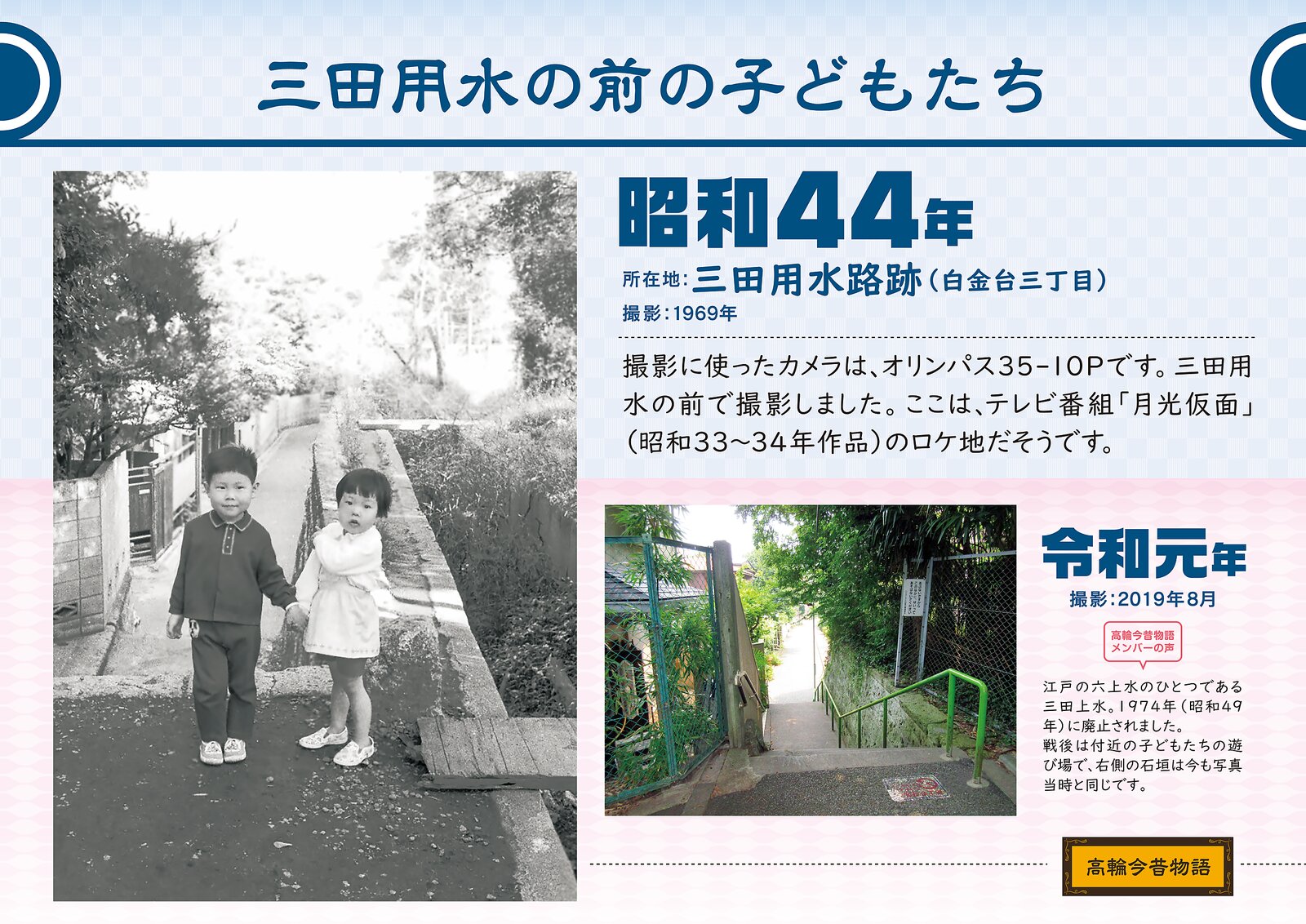
Photographed in 1969 (Showa 44) / August, 2019 (Reiwa 1)
The camera used for this shot was an Olympus 35 10P. It was taken in front of the Mita Waterway. This location is said to have been used as a filming site for the TV program “Gekko Kamen” (broadcast in 1958–1959).
Location
Site of the former Mita Waterway (3-chome oShirokanedai)
Comment from a member of Takanawa Konjaku Monogatari
Mita Josui (Mita Aqueduct) was one of Edo’s six aqueducts. It was abolished in 1974. After the war, it became a playground for children in the neighborhood, and the stone wall on the right remains the same as in the photo.
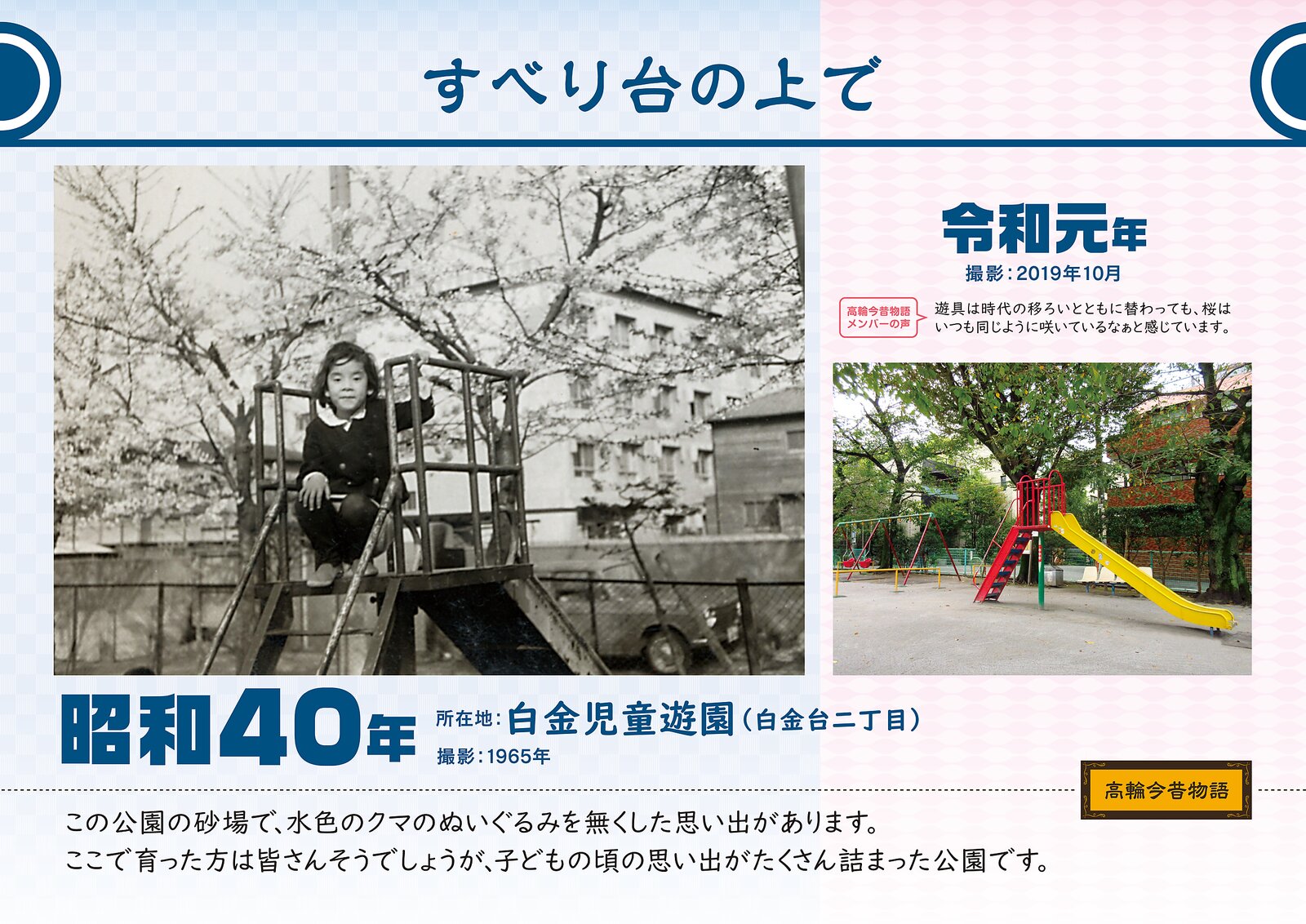
Photographed in October, 2019 (Reiwa 1) / 1965 (Showa 40)
I have a memory of losing a light blue teddy bear in the sandbox of this park. Like many others who grew up here, this place is filled with countless childhood memories.
Location
Shirokane Children’s Park, 2-chome Shirokanedai
Comment from a member of Takanawa Konjaku Monogatari
I feel that even as playground equipment changes with the passage of time, the cherry blossoms always bloom the same way.
Area
Shiroganedai
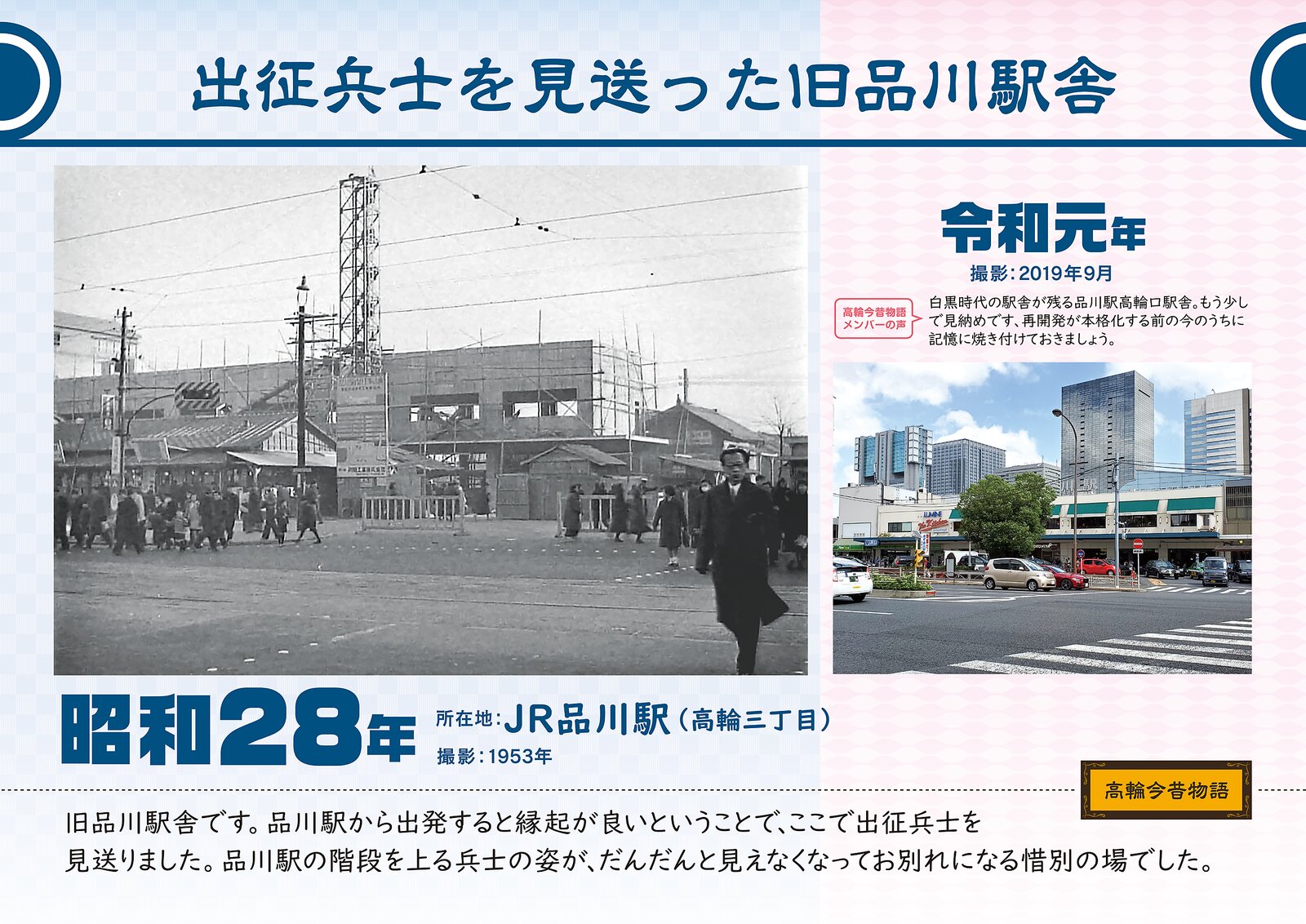
The former Shinagawa Station building where soldiers departing for the front were seen off
Produced in FY2019ed
Photographed in 1953 (Showa 28) / September, 2019 (Reiwa 1)
This is the former Shinagawa Station building. Because departing from Shinagawa Station was considered auspicious, soldiers leaving for the front were seen off here. As they climbed the station stairs, their figures gradually disappeared from view, marking a poignant moment of farewell.
Location
JR Shinagawa Station, 3-chome Takanawa
Comment from a member of Takanawa Konjaku Monogatari
Shinagawa Station’s Takanawa Exit building has remained standing since the black-and-white era. You’ll soon see it for the last time, so let’s burn it into our memory now before redevelopment begins in earnest.
Area
Takanawa
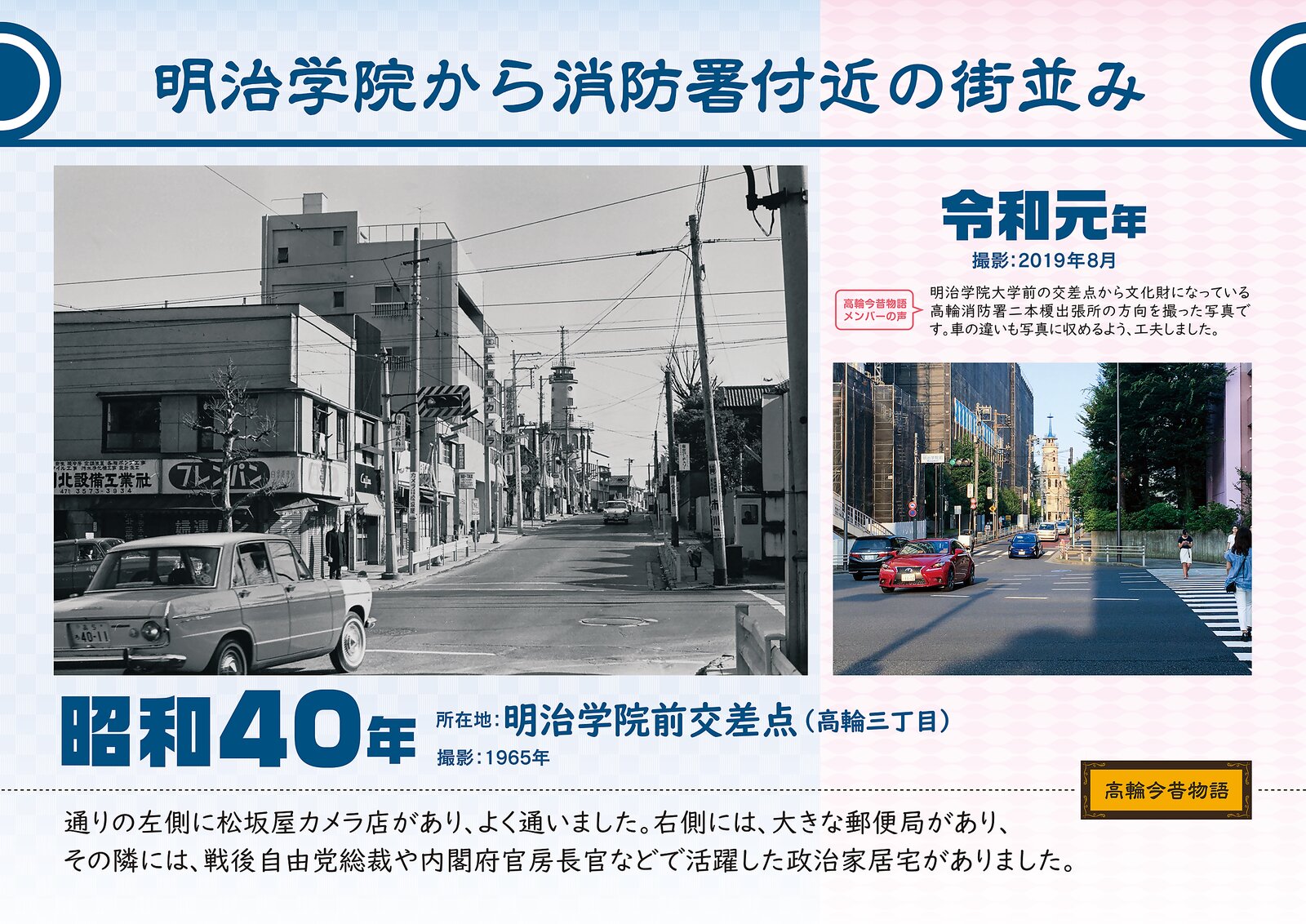
Streetscape from Meiji Gakuin toward the fire station
Produced in FY2019ed
Photographed in 1965 (Showa 40) / August, 2019 (Reiwa 1)
On the left side of the street stood the Matsuzakaya Camera Shop, which I used to visit often. On the right side was a large post office, and next to it was the residence of a politician who later served as president of the Liberal Party and as Chief Cabinet Secretary after the war.
Location
Meiji Gakuin-mae intersection, 3-chome Takanawa
Comment from a member of Takanawa Konjaku Monogatari
A photo taken from the intersection in front of Meiji Gakuin University, looking toward the Nihonenoki branch of Takanawa Fire Station, which has been designated a cultural property. I also put much effort into capturing the differences in the cars in the photo.
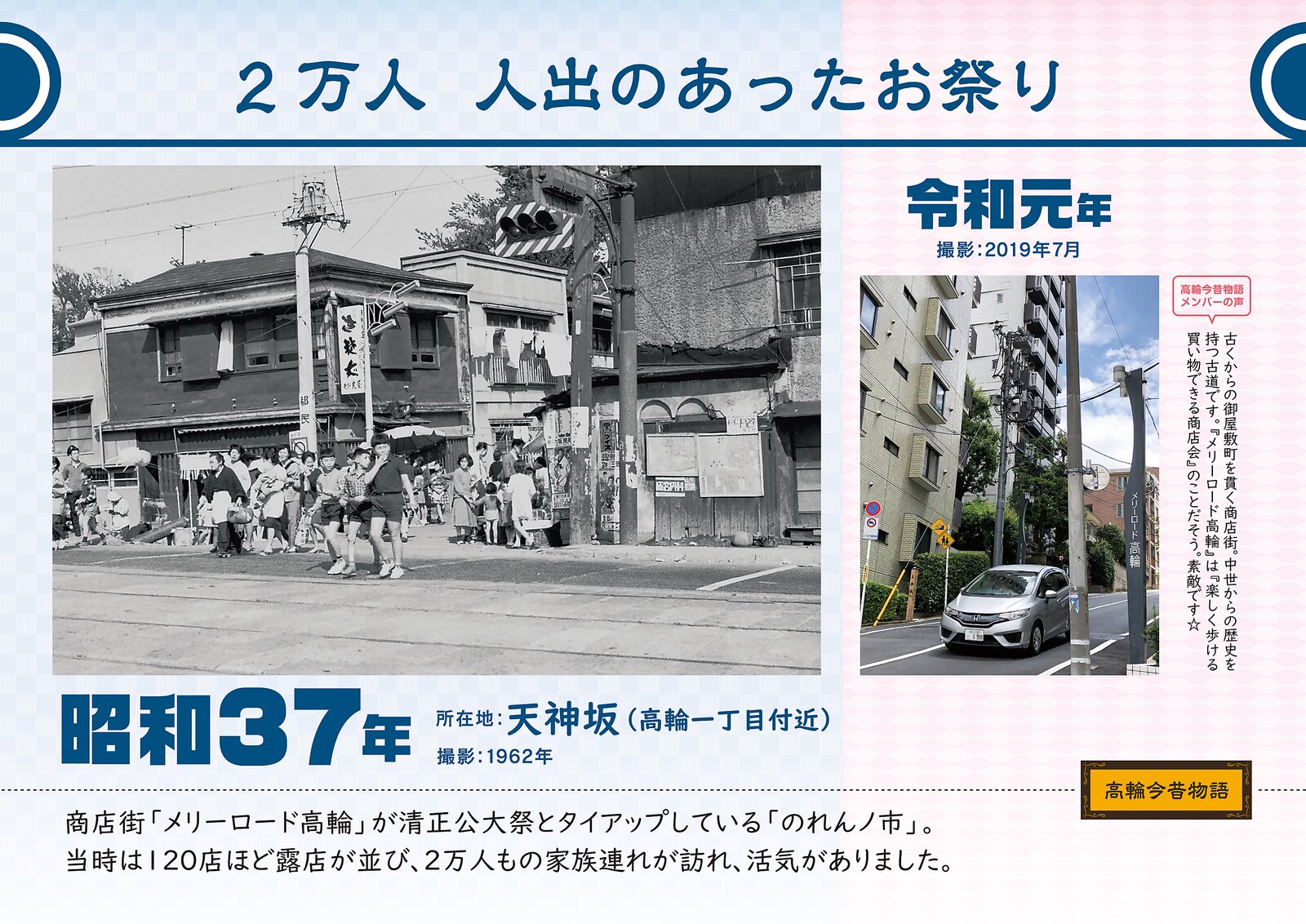
Photographed in 1962 (Showa 37) / July, 2019 (Reiwa 1)
The shopping street “Merry Road Takanawa” collaborated with the Seishōkō Grand Festival to hold the “Noren-no-Ichi.” At that time, about 120 stalls lined the street, and as many as 20,000 families visited, creating a lively and festive atmosphere.
Location
Tenjinnzaka (Around 1-chome Takanawa)
Comment from a member of Takanawa Konjaku Monogatari
A shopping street running through an old district of residential mansions, it is an ancient road with history from medieval times. “Merry Road Takanawa” apparently means “a shopping association where you can walk and shop with enjoyment.” It’s wonderful☆
Area
Takanawa
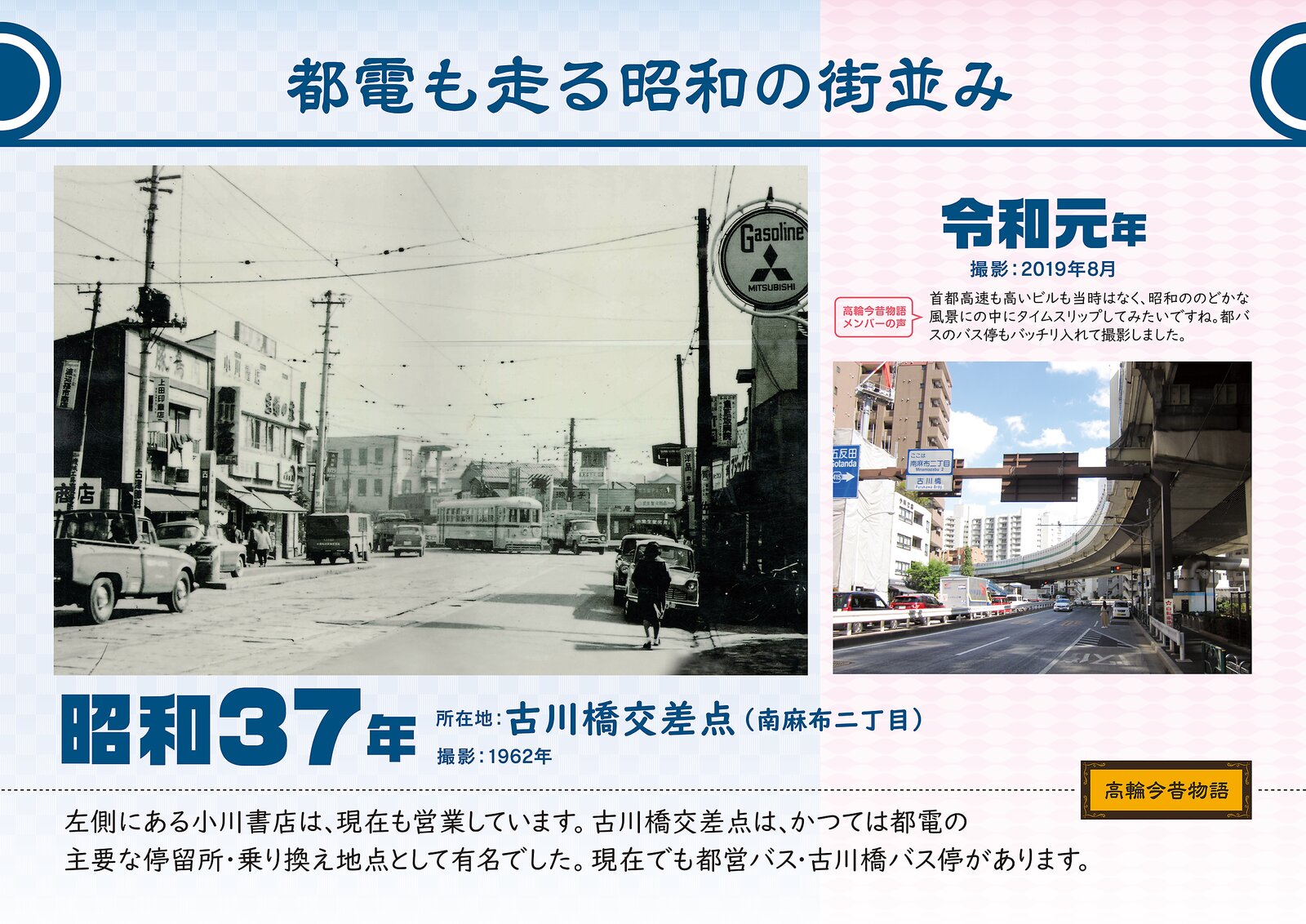
A Showa era streetscape where the Toden streetcar still ran
Produced in FY2019ed
Photographed in 1962 (Showa 37) / August, 2019 (Reiwa 1)
Ogawa Bookstore on the left is still in business today. The Furukawa bashi intersection was once known as a major stop and transfer point for the Toden streetcar. Even now, the Toei Bus stop “Furukawa bashi” remains in service.
Location
Furukawa Bashi intersection, 2-chome Minami Azabu
Comment from a member of Takanawa Konjaku Monogatari
Neither Shuto Expressway nor tall buildings existed back then. I’d like to travel back in time into that peaceful Showa-era landscape. I made sure to include the Toei bus stop in the photo.
Area
Shiroganedai
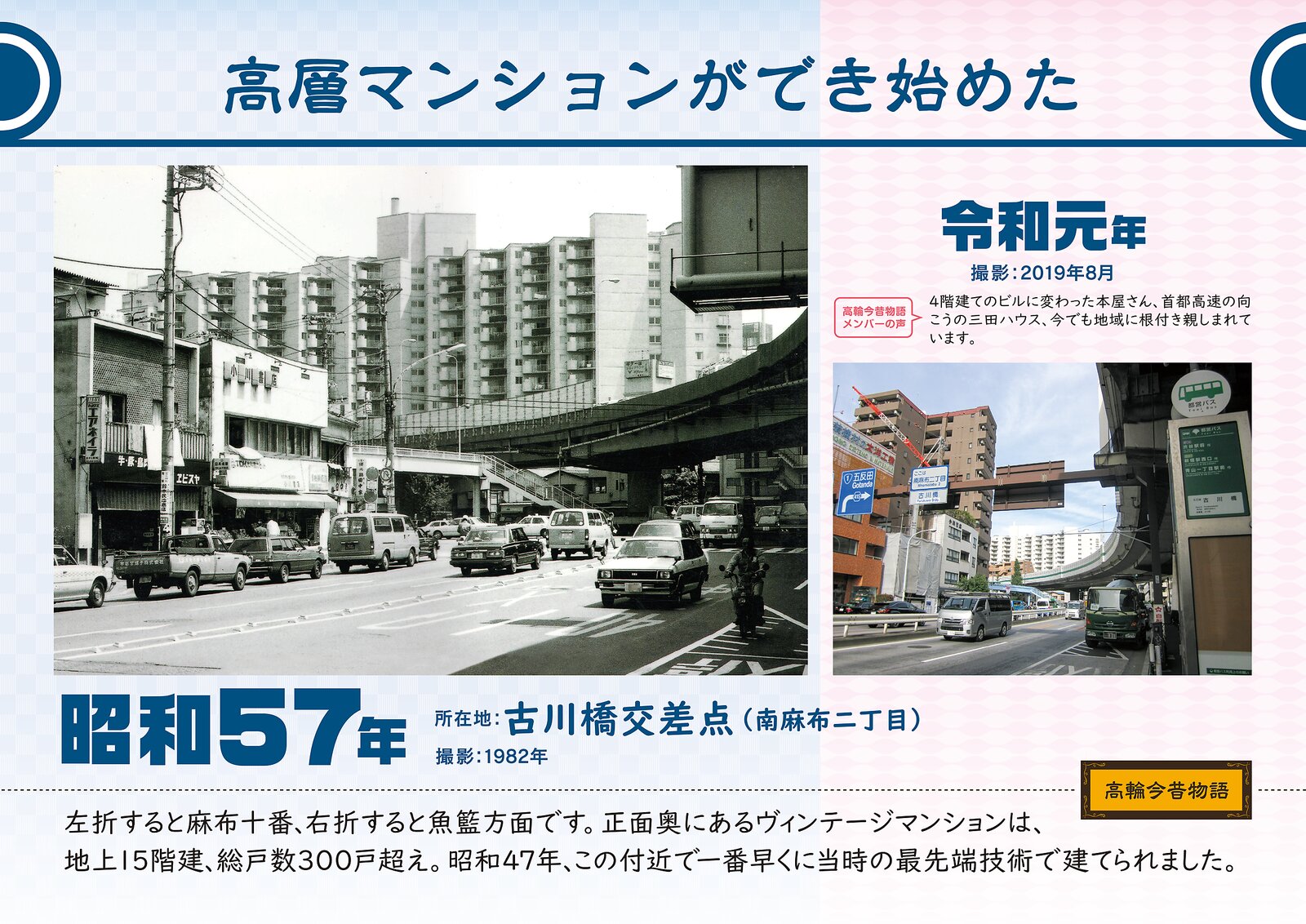
The time when high rise condominiums began to appear
Produced in FY2019ed
Photographed in 1982 (Showa 57) / August, 2019 (Reiwa 1)
Turning left leads to Azabu Juban, and turning right leads toward Gyōran. The vintage condominium seen in the distance is a 15 story building with more than 300 units. Built in 1972 (Showa 47) using the most advanced construction technology of the time, it was one of the earliest high rise residences in this area.
Location
Furukawabashi intersection, 2-chome Minami Azabu
Comment from a member of Takanawa Konjaku Monogatari
The bookstore that became a four-story building, and Mita House beyond Shuto Expressway—they’re still well-loved and deeply rooted in the community today.
Area
Shiroganedai
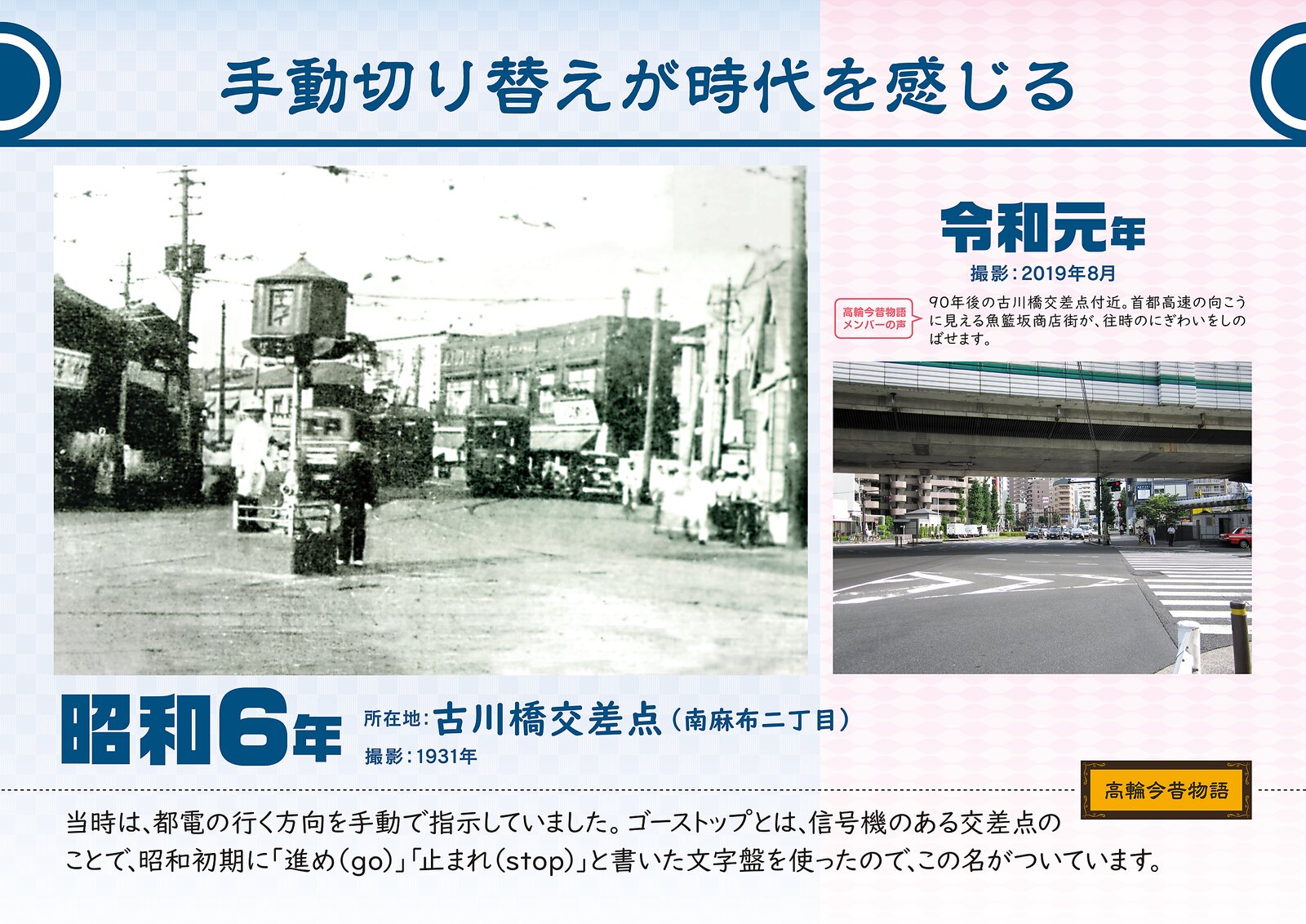
The manual switching mechanism evokes the era
Produced in FY2019ed
Photographed in 1931 (Showa 6) / August, 2019 (Reiwa 1)
In those days, the direction of the Toden streetcar was manually controlled. The term “Go Stop” referred to intersections with traffic signals. In the early Showa period, these signals used plates labeled “go” and “stop,” which is how the name originated.
Location
Furukawabashi intersection, 2-chome Minami Azabu
Comment from a member of Takanawa Konjaku Monogatari
This is near Furukawa Bridge intersection, 90 years later. The Gyoranzaka shopping street visible beyond Shuto Expressway reminds us of its former bustle.
Area
Shiroganedai
With no tall buildings, the view stretched far into the distance
Produced in FY2019ed
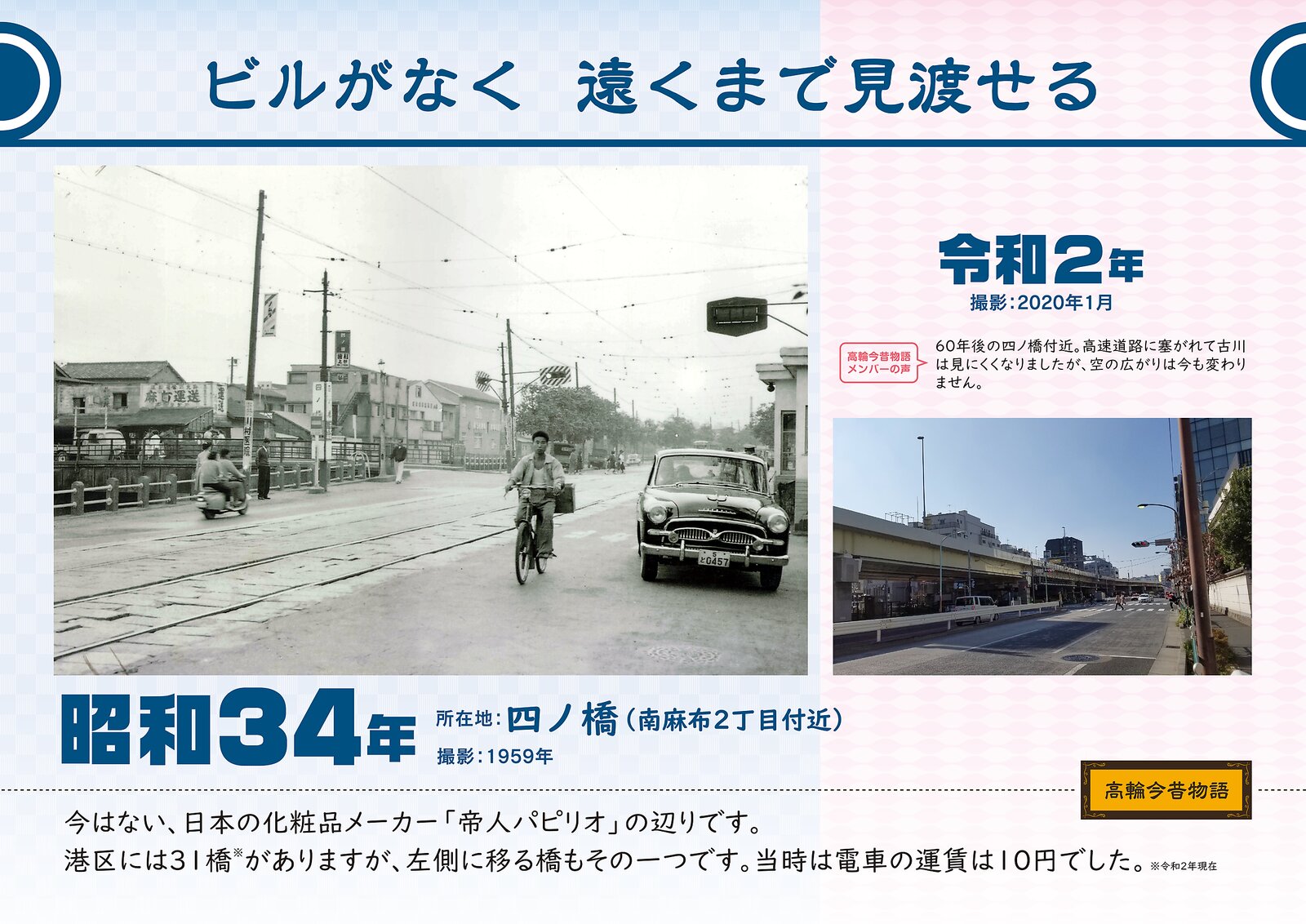
Photographed in 1959 (Showa 34) / January, 2020 (Reiwa 2)
This area was once home to the Japanese cosmetics company “Teijin Papilio,” which no longer exists today. Minato City has 31 bridges, and the one visible on the left is among them. At that time, the streetcar fare was 10 yen.
※As of 2020 (Reiwa 2)
Location
Shinohashi (around 2-chome Minami Azabu)
Comment from a member of Takanawa Konjaku Monogatari
This is near Shinohashi, 60 years later. It has become hard to see Furukawa River, which is blocked by the expressway, but the expanse of sky remains unchanged.
Area
Shiroganedai
Sisters at Kamezuka Park
Produced in FY2019ed
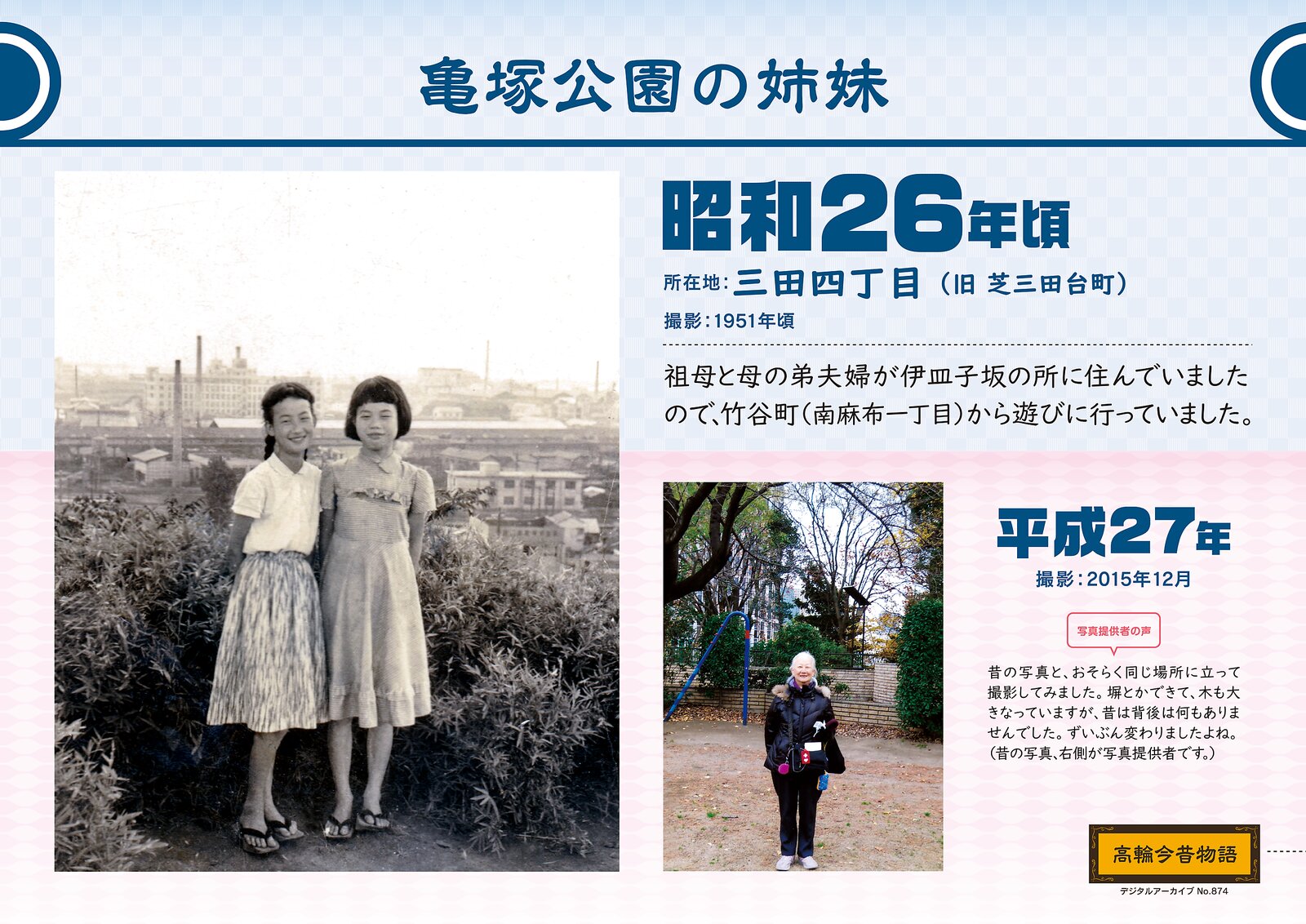
Photographed in 1951 (Showa 26) / December, 2015 (Heisei 27)
My grandmother, as well as my mother’s younger brother and his wife, lived at Isaragozaka, so I used to visit from Takeyacho (1-chome Minami-Azabu).
Location
4-chome Mita (former Shiba Mitadai Cho)
Comment from the photo provider
I tried taking a photo standing at what was probably the same place as the old photo. There’s a wall now and the trees have grown, but back then there was nothing behind us. It’s changed quite a bit, hasn’t it? (In the old photo, the photo provider is on the right.)
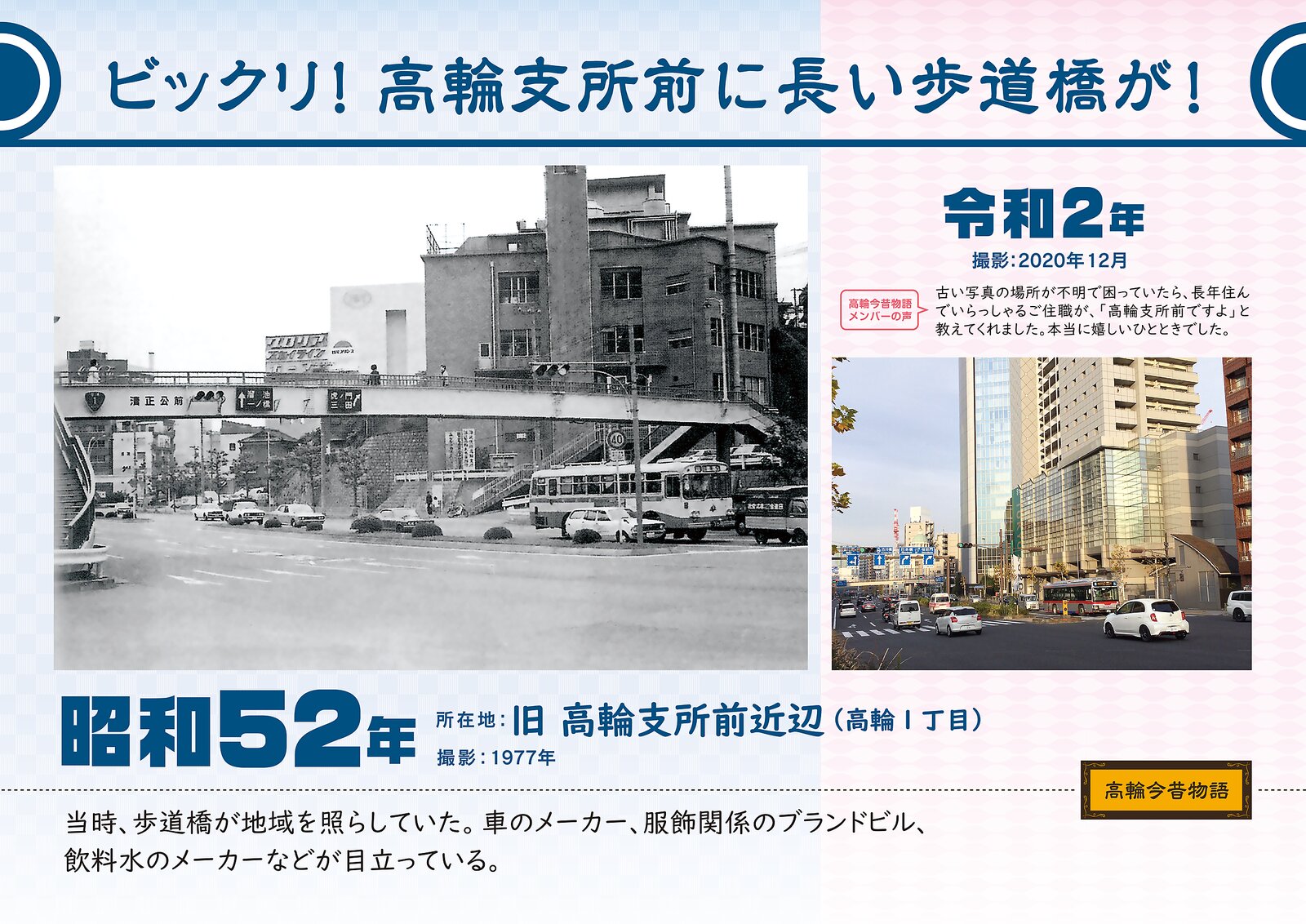
Surprisingly, there used to be a long pedestrian bridge in front of the Takanawa Branch Office.
Produced in FY2020ed
Photographed in around 1977 (Showa 52) / December, 2020 (Reiwa 2)
At that time, the pedestrian bridge illuminated the neighborhood. Buildings belonging to car manufacturers, fashion brands, and beverage companies stood out prominently.
Location
Around the former Takanawa Branch Office (1-chome Takanawa)
Comment from a member of Takanawa Konjaku Monogatari
We were having trouble finding the location in the old photo, but the head priest who has lived here for many years told us, “It’s in front of Takanawa Regional City Office.” It was truly a happy moment.
Area
Takanawa
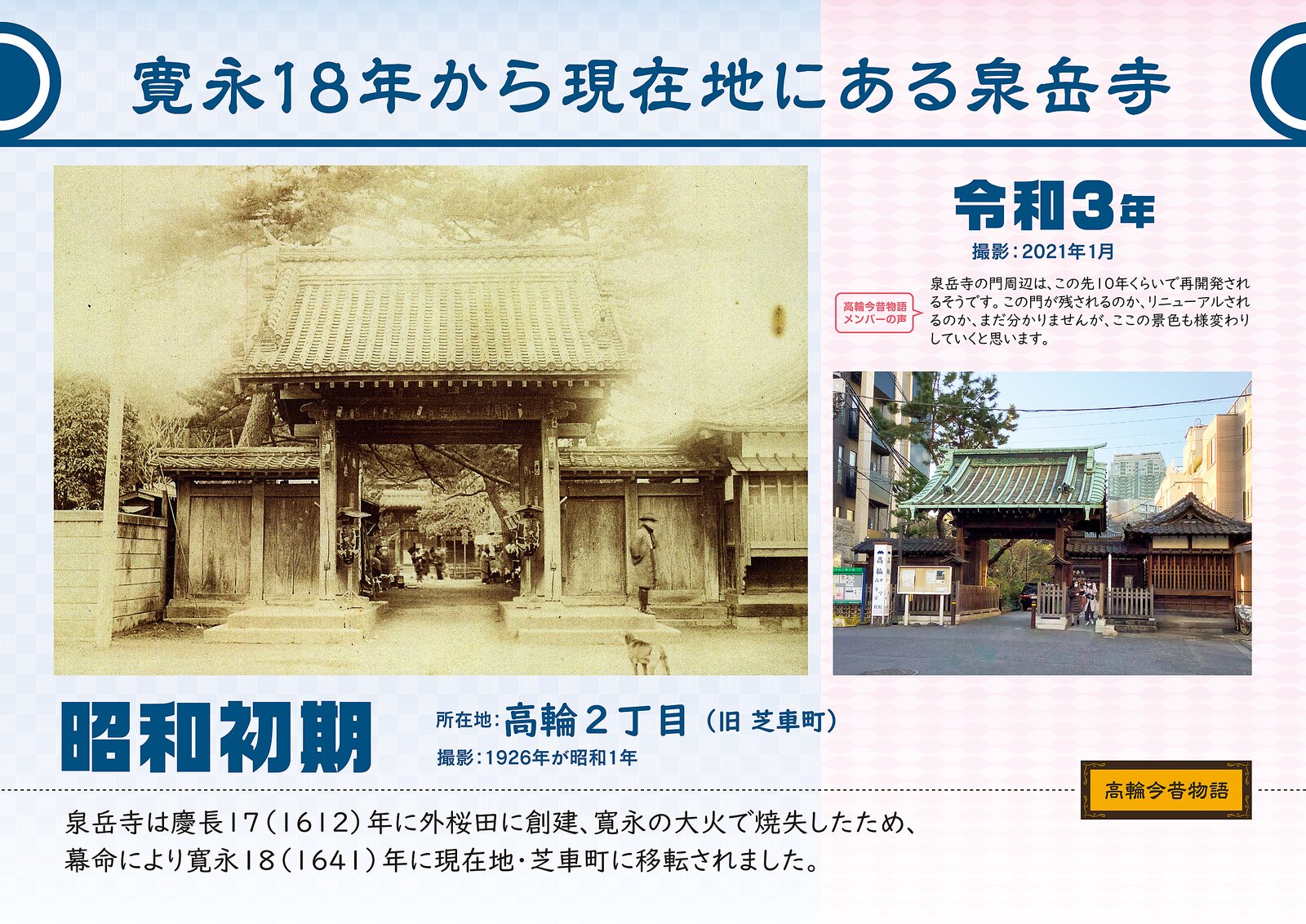
Sengakuji Temple has stood at its present location since 1641 (the 18th year of the Kan’ei era)
Produced in FY2020ed
Photographed in early Showa era / January, 2021 (Reiwa 3)
Sengakuji Temple was originally founded in 1612 (Keichō 17) in Soto Sakurada. After it was destroyed in the Great Fire of the Kan’ei era, it was relocated by order of the shogunate to its present site in Shiba Kurumamachi in 1641 (Kan’ei 18).
Location
2-chome Takanawa (former Shiba-kuruma cho)
Comment from a member of Takanawa Konjaku Monogatari
The area around the gate of Sengakuji will apparently be redeveloped over the next 10 years or so. We don’t yet know if this gate will be preserved or renovated, but I think the scenery here will change dramatically.
Area
Takanawa
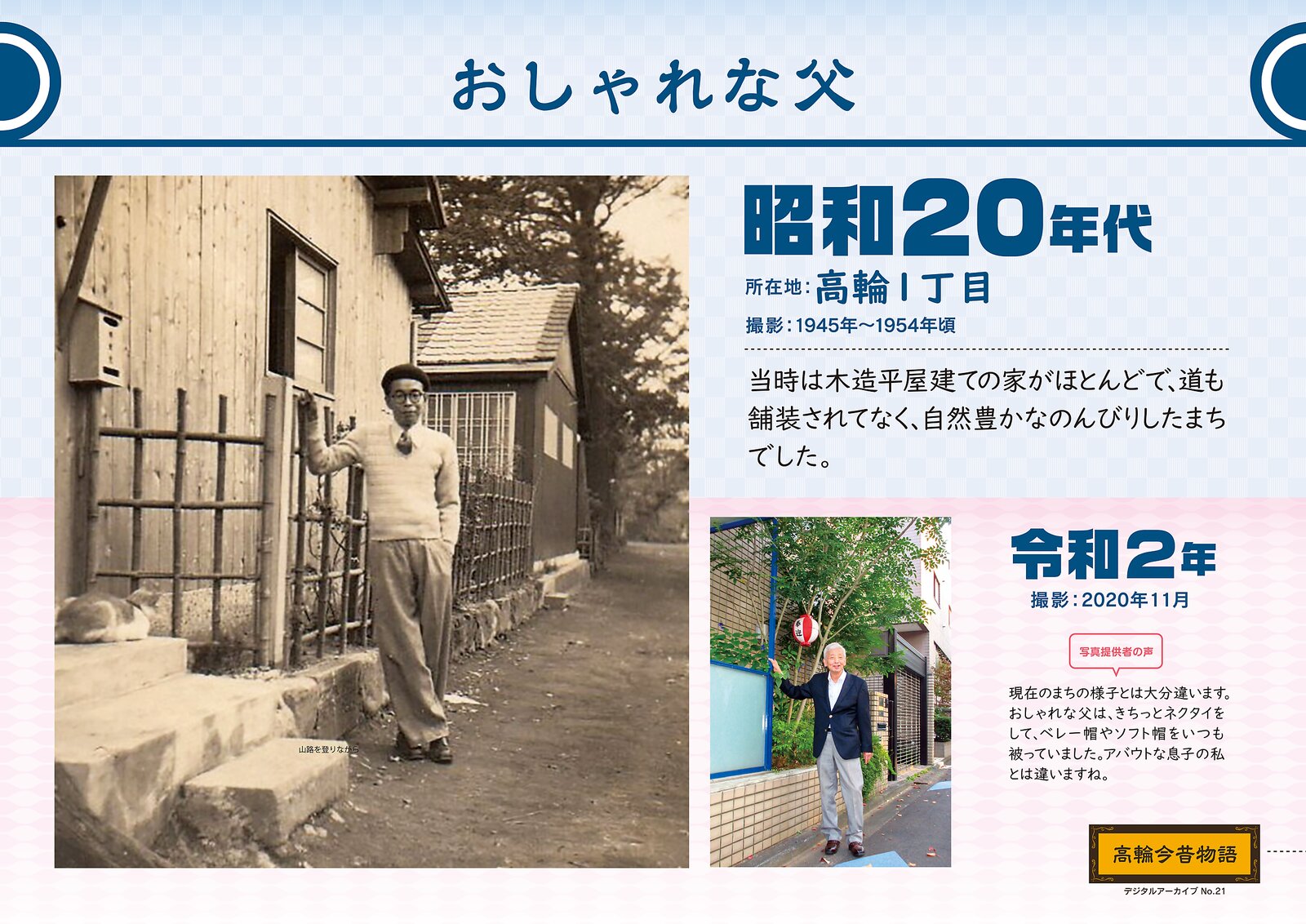
My stylish father
Produced in FY2020ed
Photographed in 1945-1954 (Showa 20s) / January, 2020 (Reiwa 2)
Most of the houses at that time were single story wooden structures, and the roads were unpaved. It was a peaceful town surrounded by nature.
Location
1-chome Takanawa
Comment from the photo provider
It’s quite different from what the town looks like today. My stylish father always wore his tie neatly, along with a beret or soft hat. He was very different from me, his casual son.
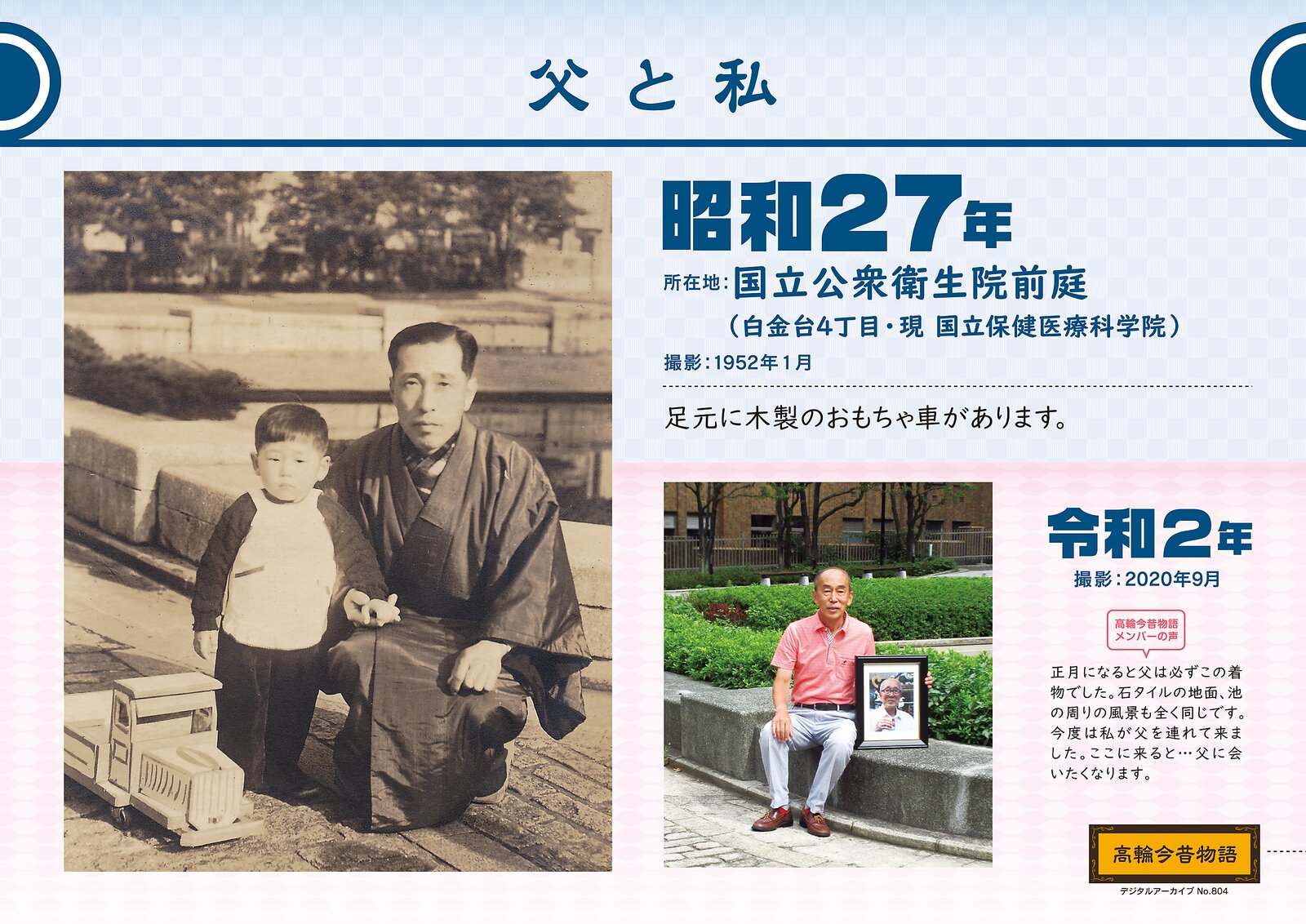
Photographed in January, 1952 (Showa 27) / September, (Reiwa 2)
There was a wooden toy car at my feet.
Location
Front garden of the former National Institute of Public Health (4-chome Shirokanedai, the present National Institute of Public Health and Medical Research)
Comment from a member of Takanawa Konjaku Monogatari
Father always wore this kimono for New Year’s. The stone-tiled ground and scenery around the pond are exactly the same. I brought my father here this time. When I come here… I start to miss my father.
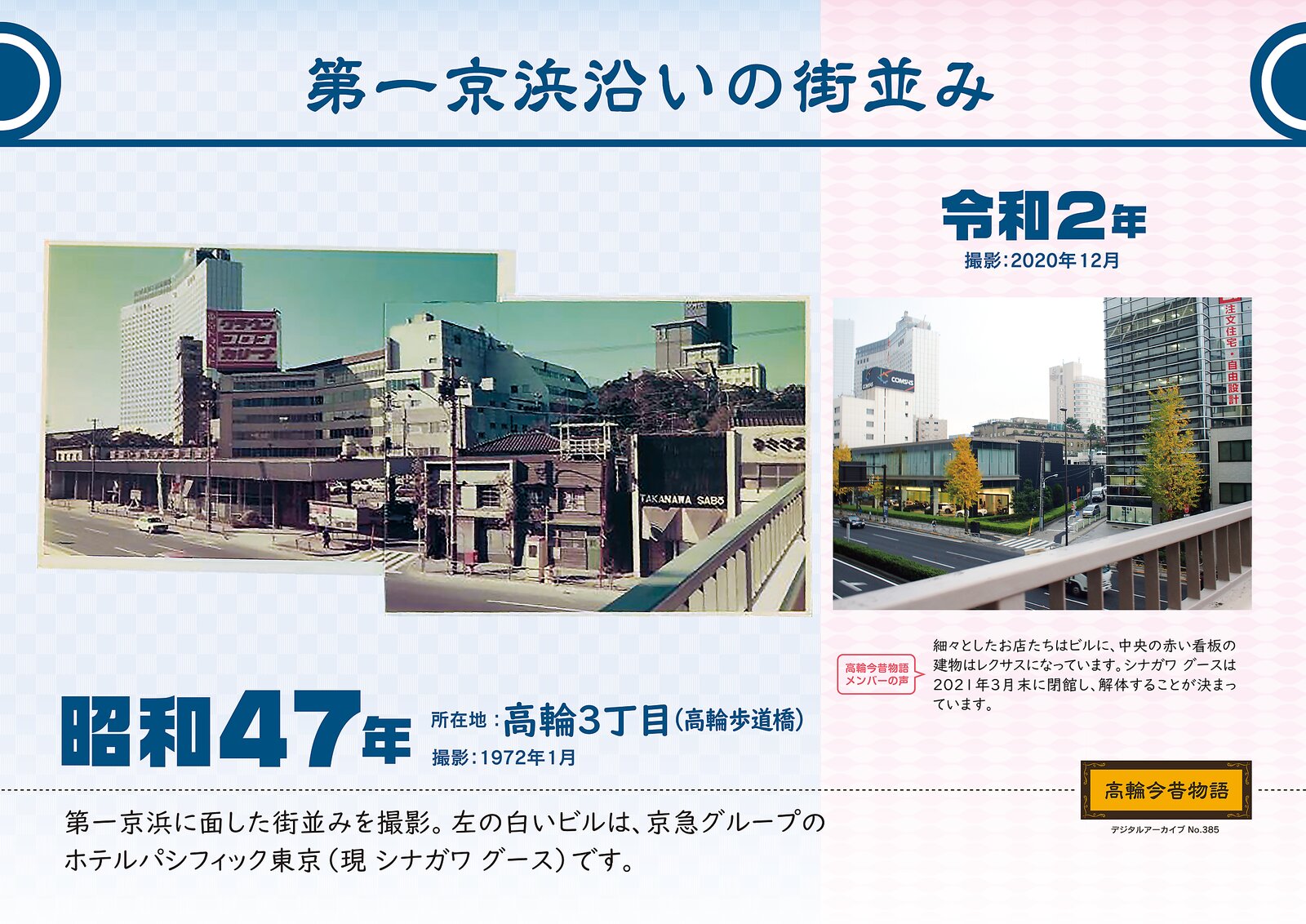
A shot of the cityscape, facing Dai-ichi Keihin. The white building on the left is the Hotel Pacific Tokyo (present SHINAGAWA GOOS) of the Keikyu Group.
Location
3-chome Takanawa (Takanawa Footbridge)
Comment from a member of Takanawa Konjaku Monogatari
The small shops have become buildings, and the building with the red sign in the center has become Lexus. SHINAGAWA GOOS closed at the end of March 2021 and is scheduled to be demolished.
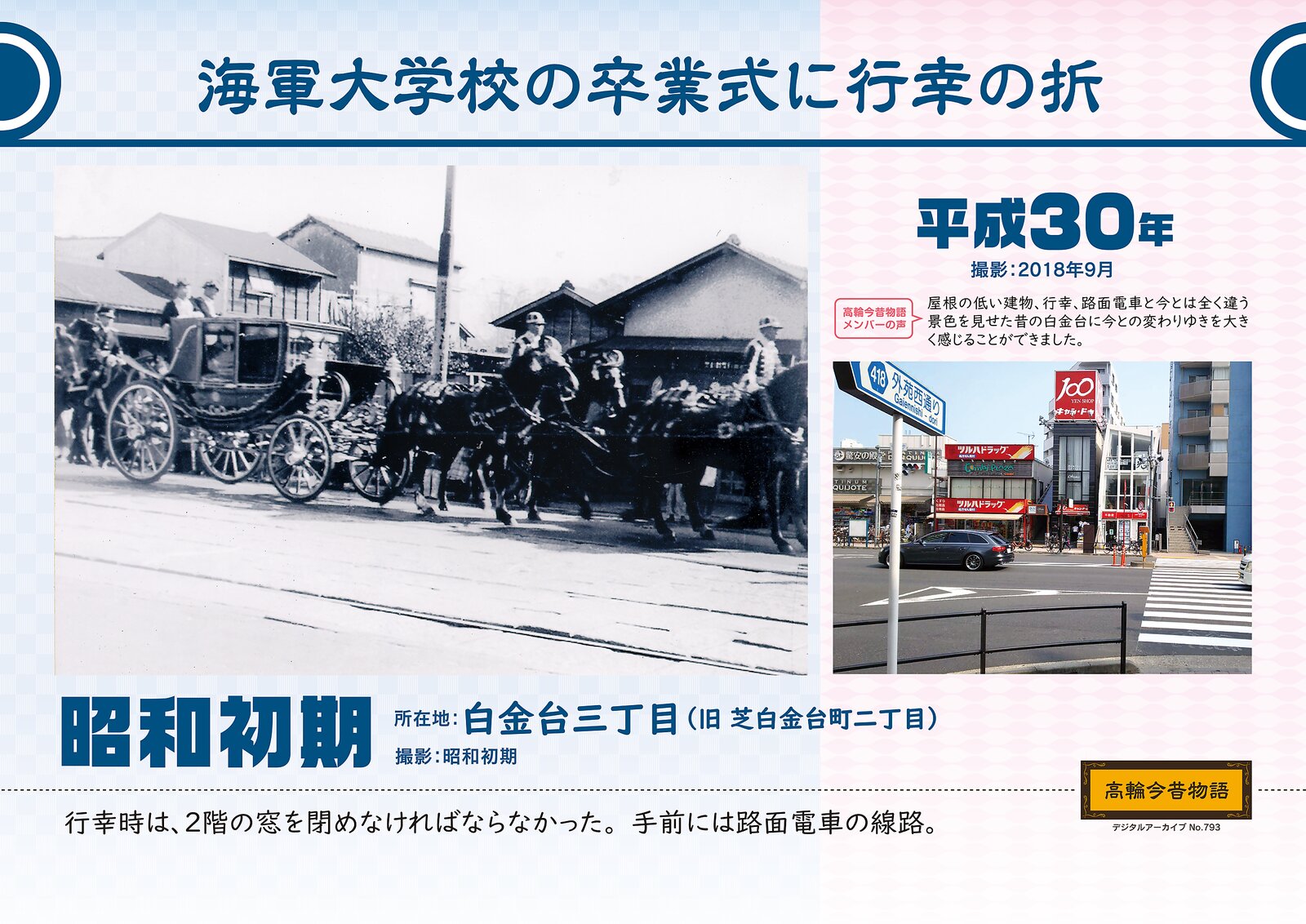
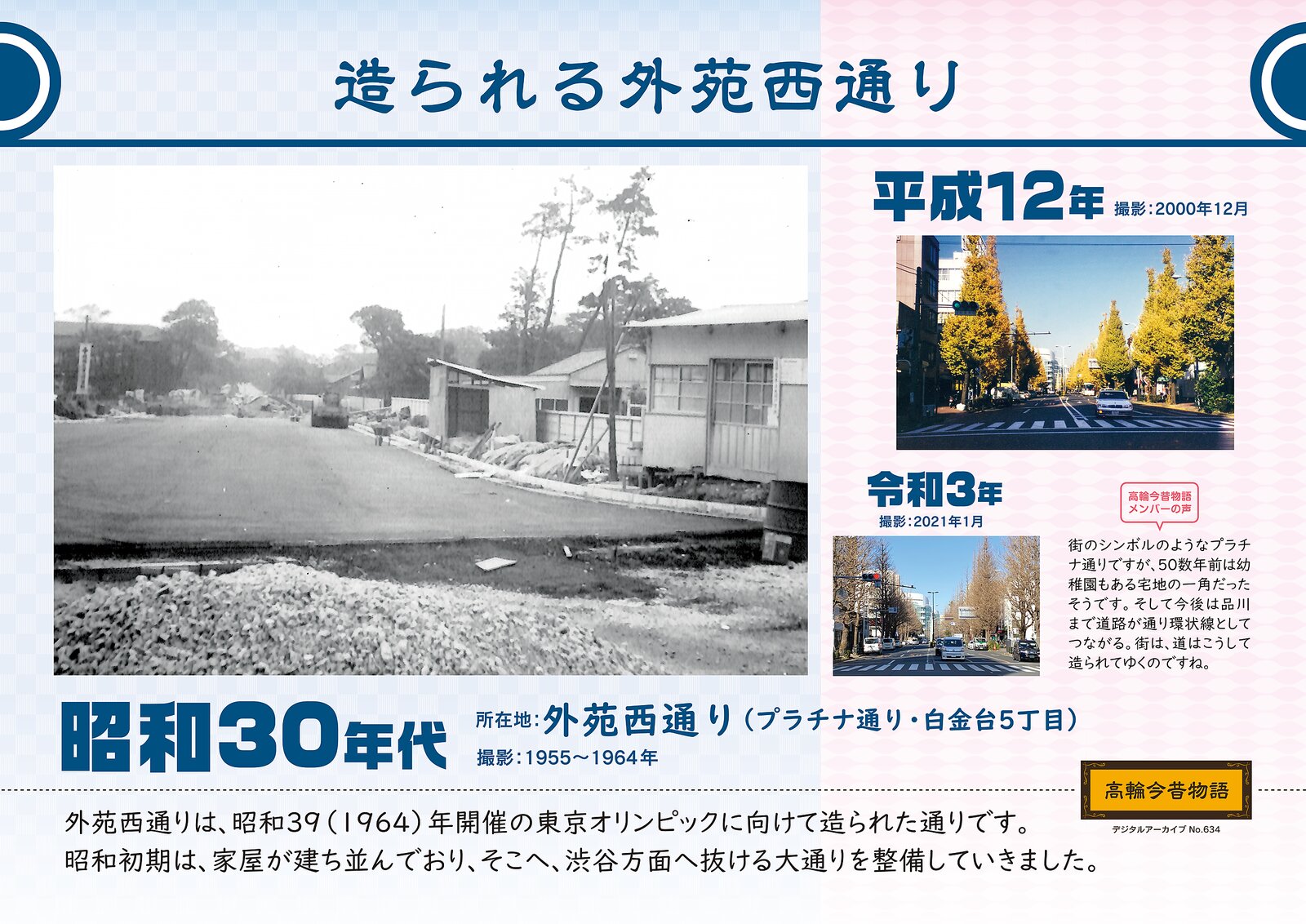
Gaien Nishi Street (Platinum Street) was constructed for the 1964 Tokyo Olympics. In the early Showa era, there was no Gaien Nishi Street (Platinum Street), and houses were lined up. A major street leading to Shibuya was then developed there.
Location
Gaien Nishi Street (Platinum Street / 5-chome Shirokanedai)
Comment from a member of Takanawa Konjaku Monogatari
Platinum Street is like a symbol of the town, but over 50 years ago, it was apparently part of a residential area and even had a kindergarten. In the future, the road will extend to Shinagawa and connect as a ring road. This is how towns and roads are built.
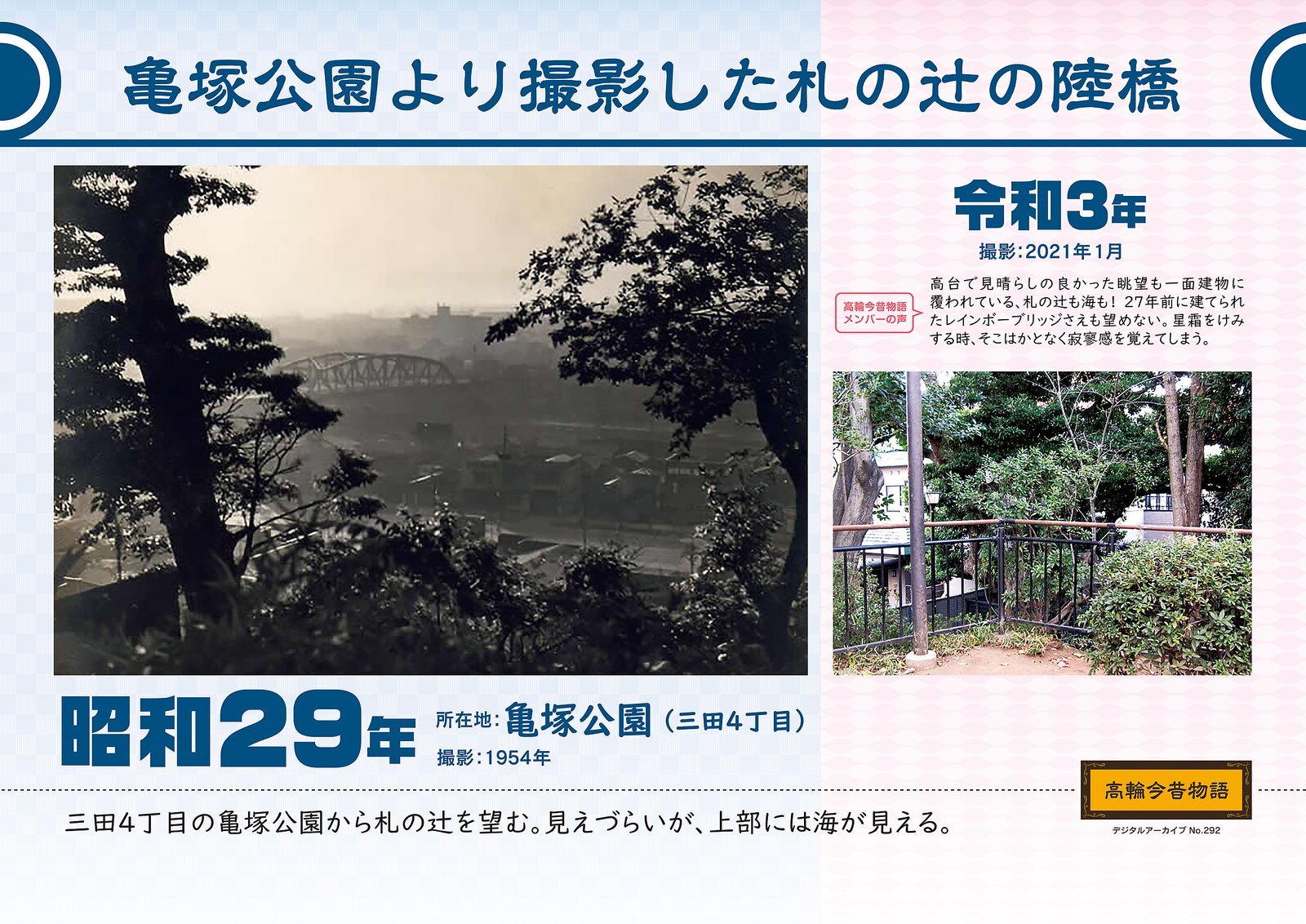
Fuda-no-tsuji overpass photographed from Kamezuka Park
Produced in FY2020ed
Photographed in 1954 (Showa 29) / January, 2021 (Reiwa 3)
A view of Fuda-no-tsuji from Kamezuka Park in Mita 4-chome. It is difficult to make out, but the sea is visible in the upper part of the photo.
Location
Kamezuka Park, 4-chome Mita
Comment from a member of Takanawa Konjaku Monogatari
The previously unobstructed view from the plateau is now covered entirely by buildings—both Fudanotsuji and the sea! Even Rainbow Bridge, built 27 years ago, can’t be seen. When considering the passage of time, one feels a certain loneliness.
Photographed in 1950 (Showa 25) / December, 2020 (Reiwa 2)
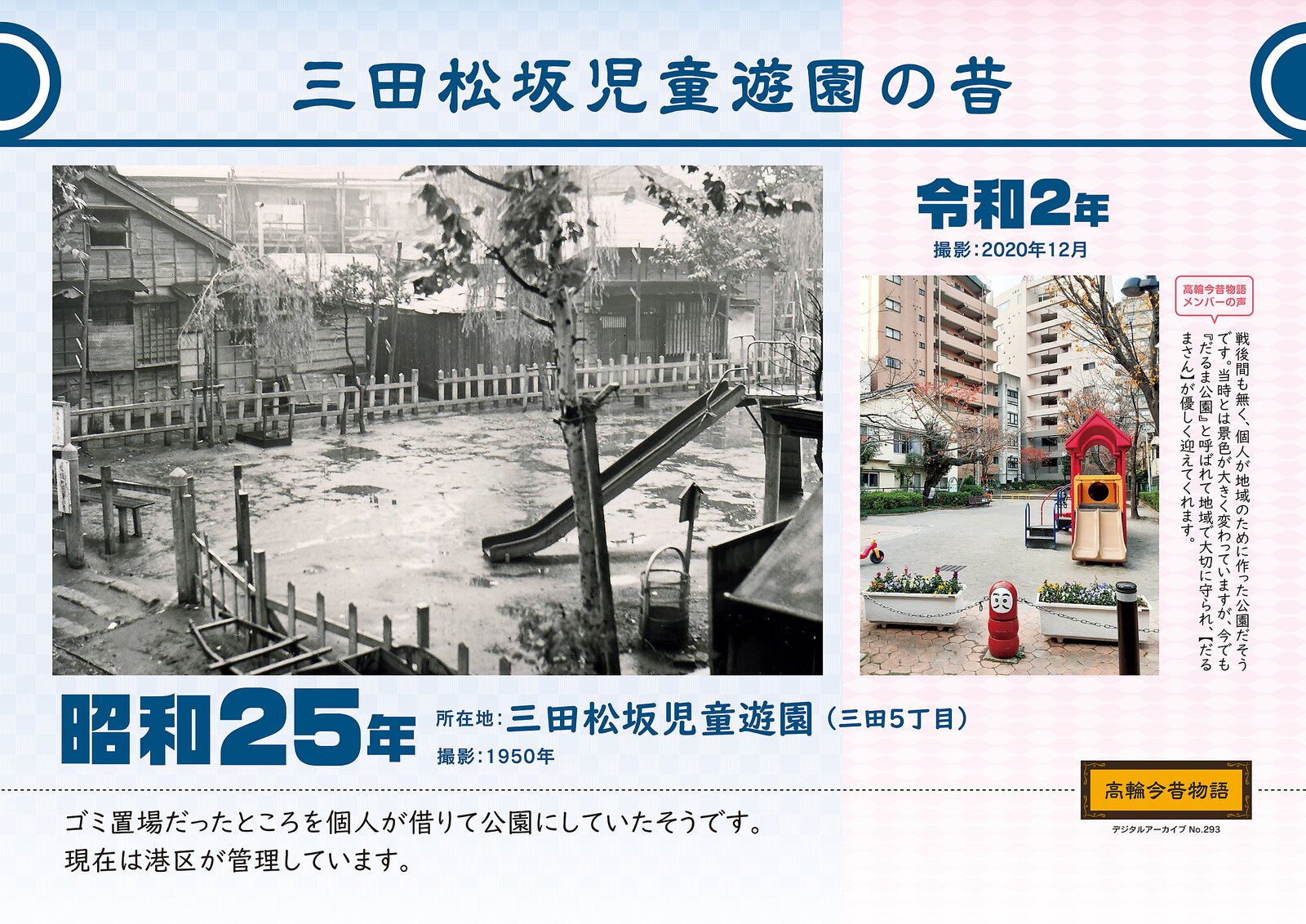
The park was established by the city after private citizens had been borrowing a garbage dump to use as a park.
Location
Mita Matsuzaka Children’s Park, 5-chome Mita
Comment from a member of Takanawa Konjaku Monogatari
This park was apparently created by an individual for the community after the war. Though the scenery has changed greatly from then, it’s still called “Daruma Park” today, carefully preserved by the community, where “Daruma-san” welcomes you kindly.
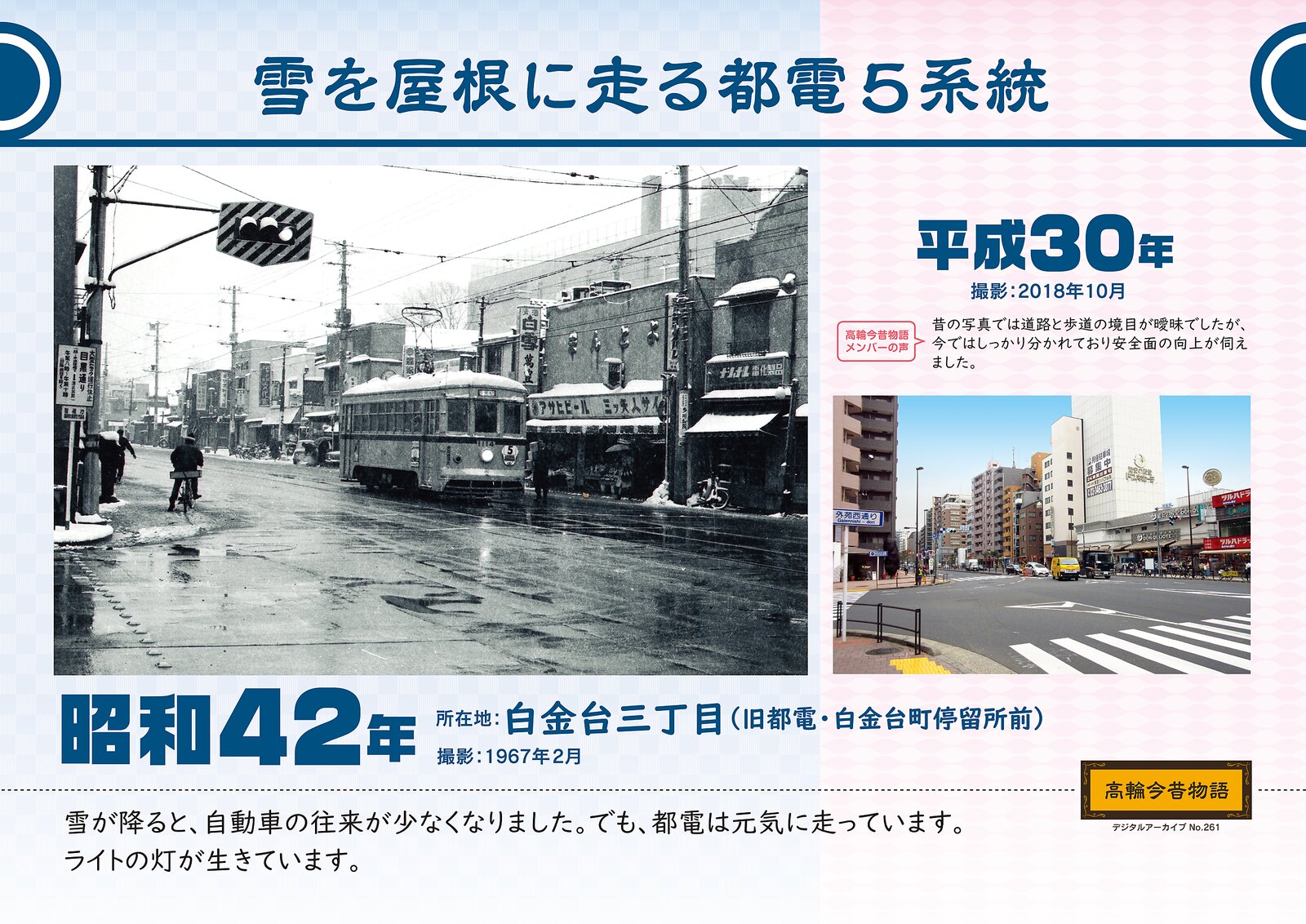
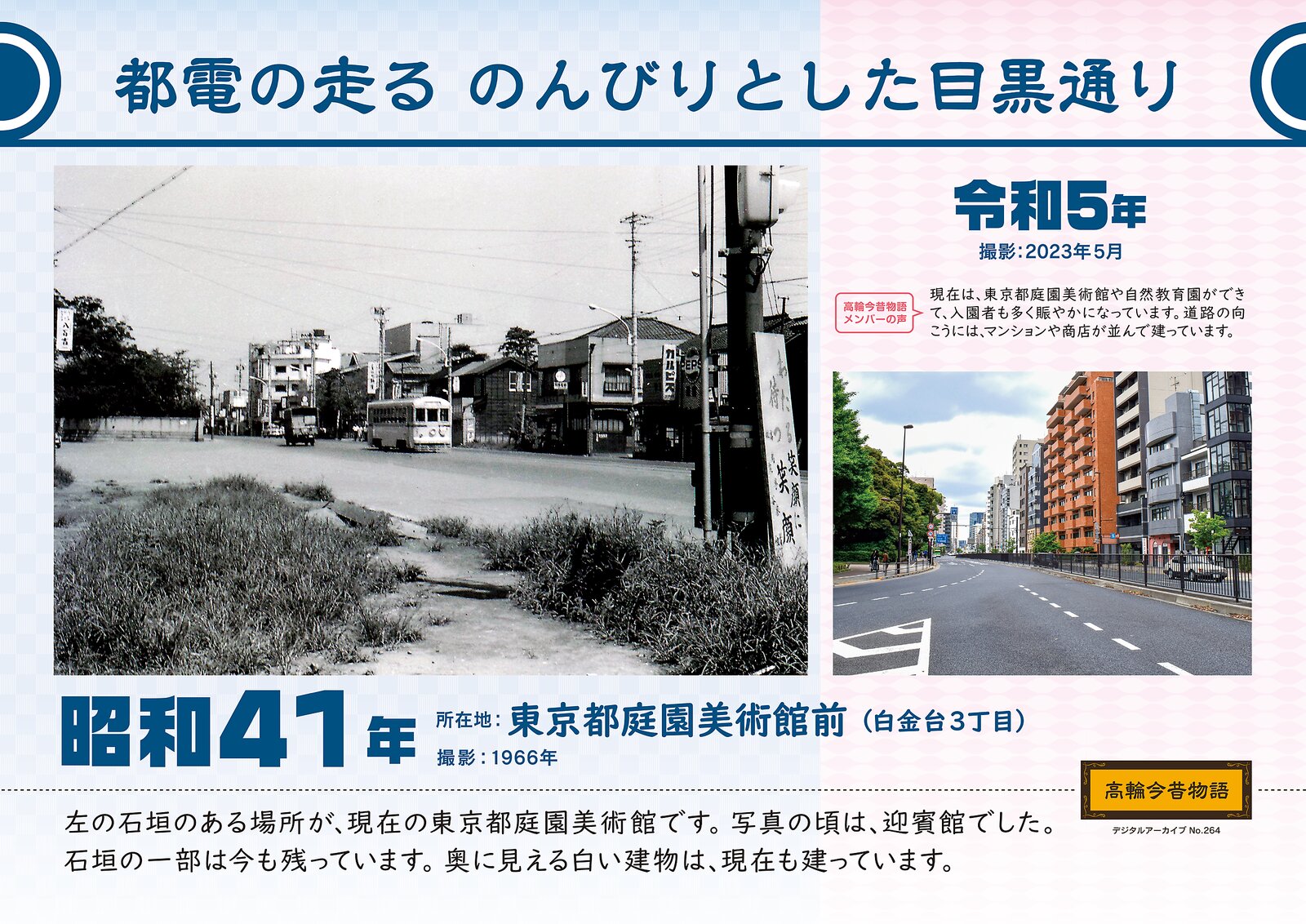
Toden streetcar running at a leisurely pace along Meguro Street
Produced in FY2023ed
Photographed in 1966 (Showa 41) / May, 2023 (Reiwa 5)
The area with the stone wall on the left side of the photo is the site of present Tokyo Metropolitan Teien Art Museum. At the time of the photo, it was the State Guest House. Part of the stone wall still remains today. The white building visible in the back also still stands.
Location
In front of Tokyo Metropolitan Teien Art Museum, 3-chome Shirokanedai
Comment from a member of Takanawa Konjaku Monogatari
With the Tokyo Metropolitan Teien Art Museum and Institute for Nature Study standing there today, it’s become lively with many visitors. Rows of apartments and shops stand across the road.
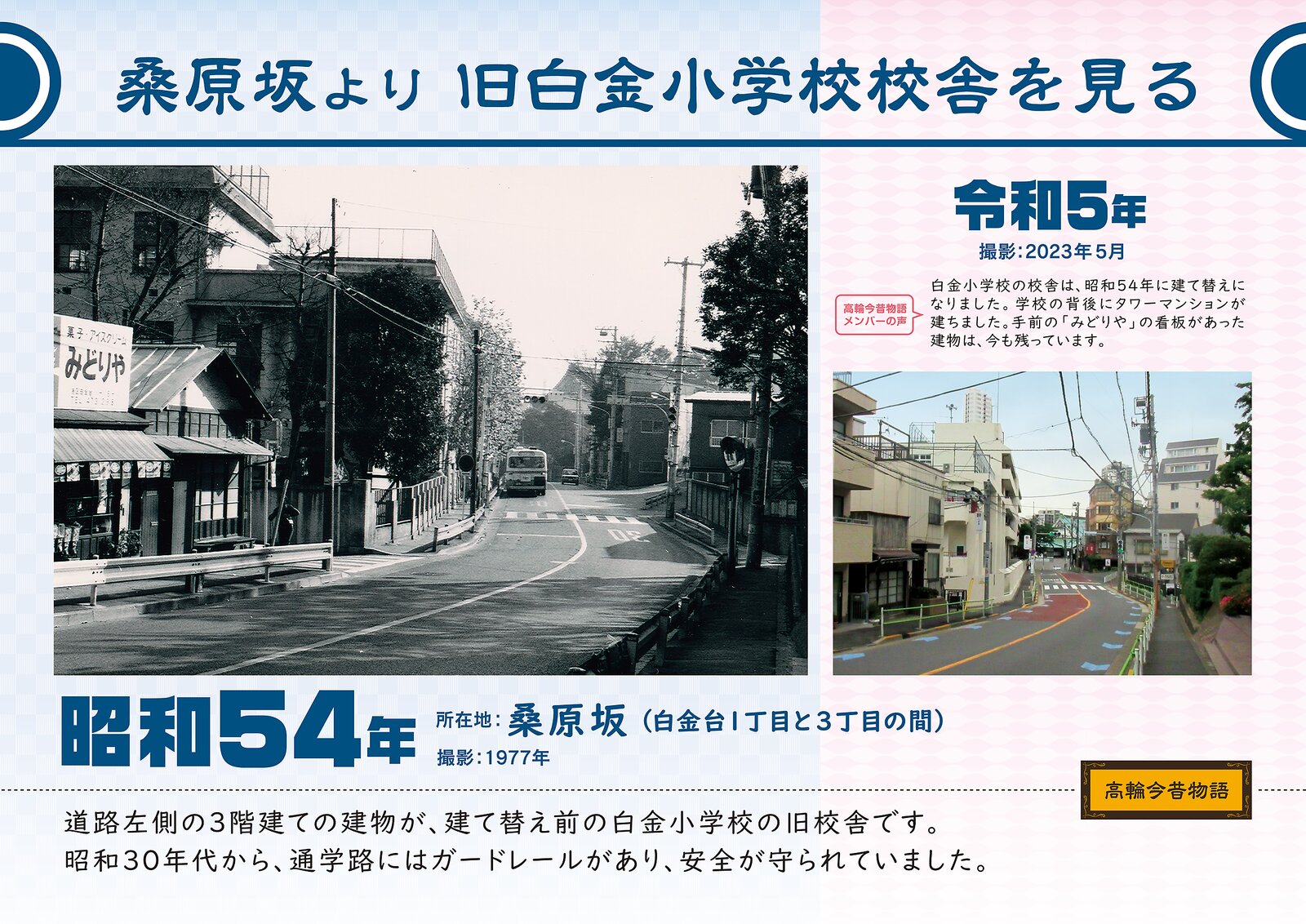
View of the former Shirokane Elementary School building from Kuwabara-zaka
Produced in FY2023ed
Photographed in 1977 (Showa 54) / May, 2023 (Reiwa 5)
The three story building on the left is the old school building of Shirokane Elementary School before it was rebuilt. Since the Showa 30s (1955-1964), guardrails had been installed along the school route to ensure children’s safety.
Location
Kuwabara-zaka (between1- and 3-chome Shirokanedai)
Comment from a member of Takanawa Konjaku Monogatari
The Shirokane Elementary School building was rebuilt in 1979. A tower apartment was built behind the school. The building where the “Midoriya” sign was remains even now.
Area
Shiroganedai
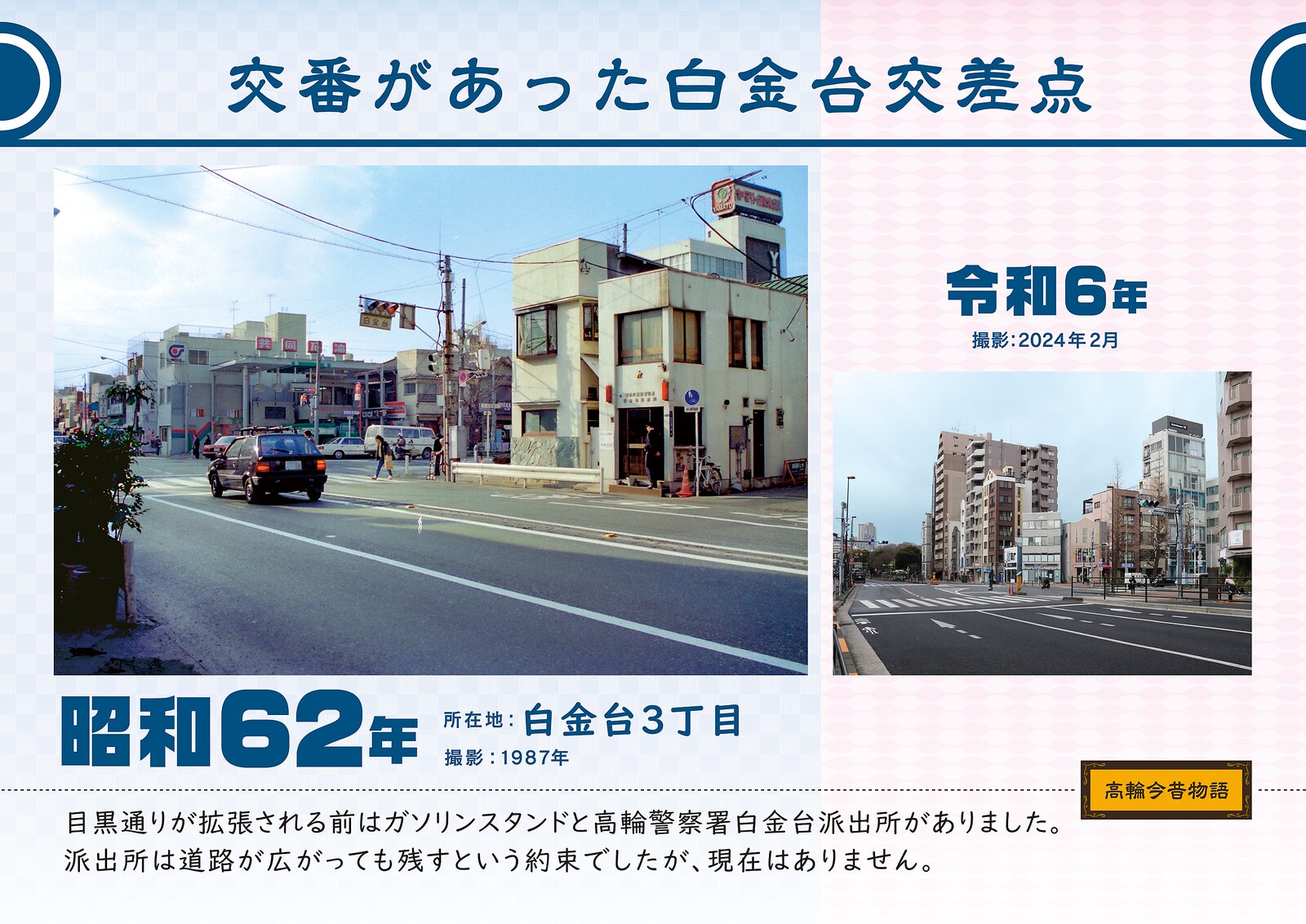
Shirokanedai intersection, where a police box once stood
Produced in FY2023ed
Photographed in 1987 (Showa 62) / February, 2024 (Reiwa 6)
Before Meguro Street was widened, there was a gas station and the Shirokanedai Police Box of the Takanawa Police Station. Although there had been a promise to maintain the police box even after the road expansion, it no longer exists today.
Location
3-chome Shirokanedai
Area
Shiroganedai
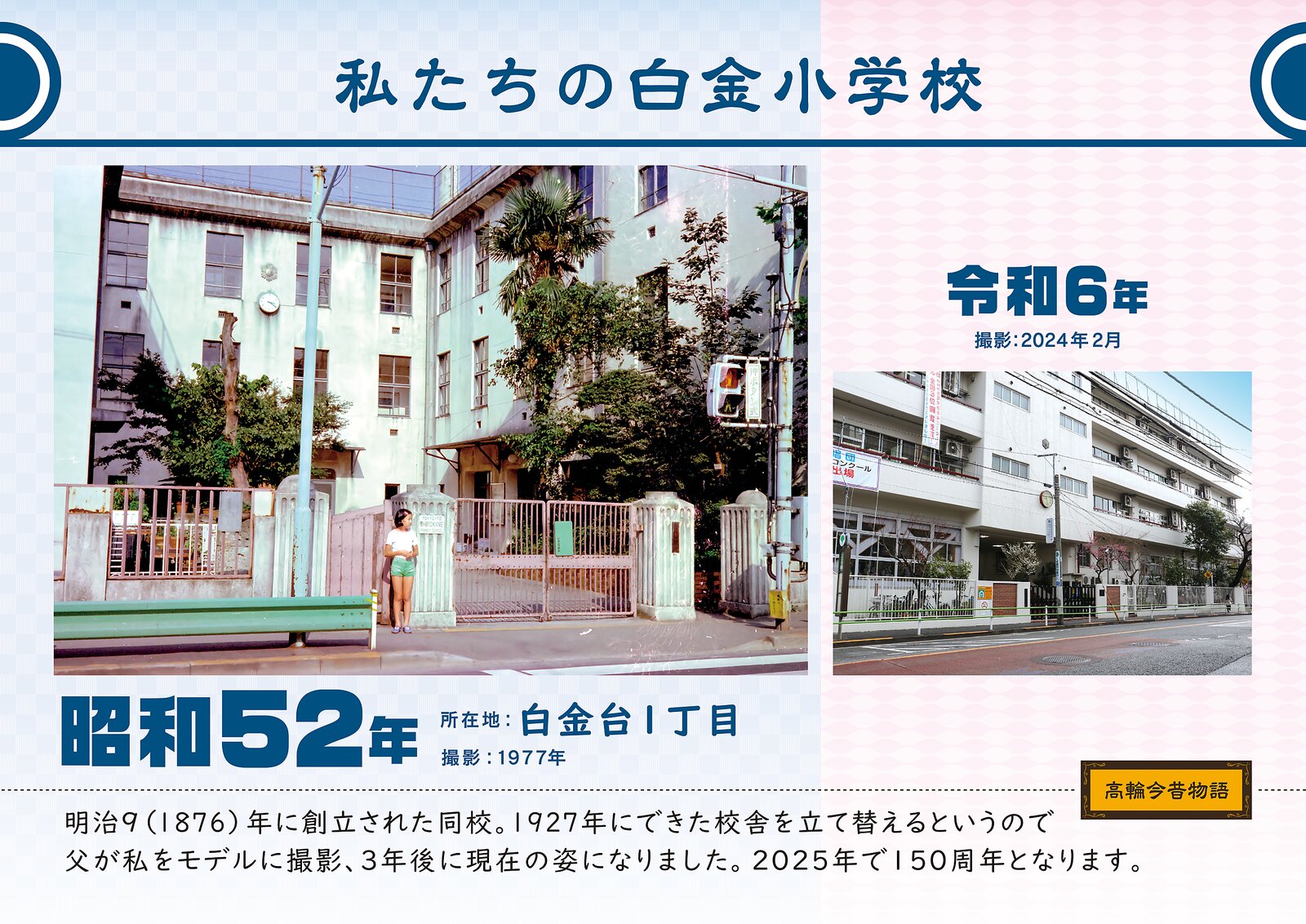
Our Shirokane Elementary School
Produced in FY2023ed
Photographed in 1977 (Showa 52) / February, 2024 (Reiwa 6)
The school was founded in 1876 (Meiji 9). This photo was photographed by my father using me as the model when plans had been made to rebuild the school building constructed in 1927. Three years later, it took on the form it has today. In 2025, the school will celebrate its 150th anniversary.
Location
1-chome Shiroganedai<>/p>
Area
Shiroganedai
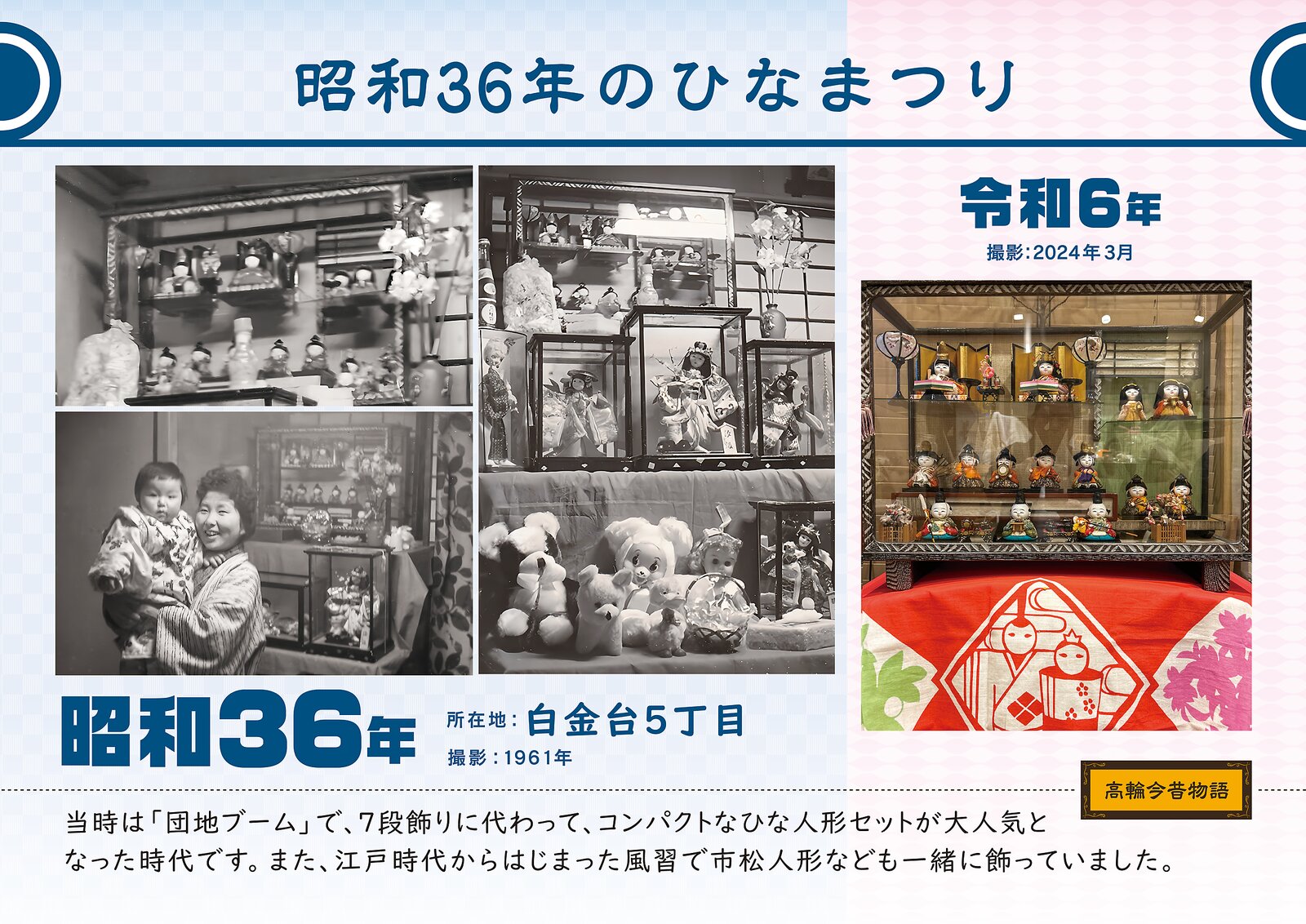
Hinamatsuri in 1961 (Showa 36)
Produced in FY2023ed
Photographed in 1961 (Showa 36) / March, 2024 (Reiwa 6)
It was the era of the “apartment complex (‘Danchi’) boom,” when compact Hina doll sets became extremely popular in stead of the traditional seven tier display. Following a custom that dates back to the Edo period, Ichimatsu dolls were also displayed together.
Location
5-chome Shiroganedai
Area
Shiroganedai
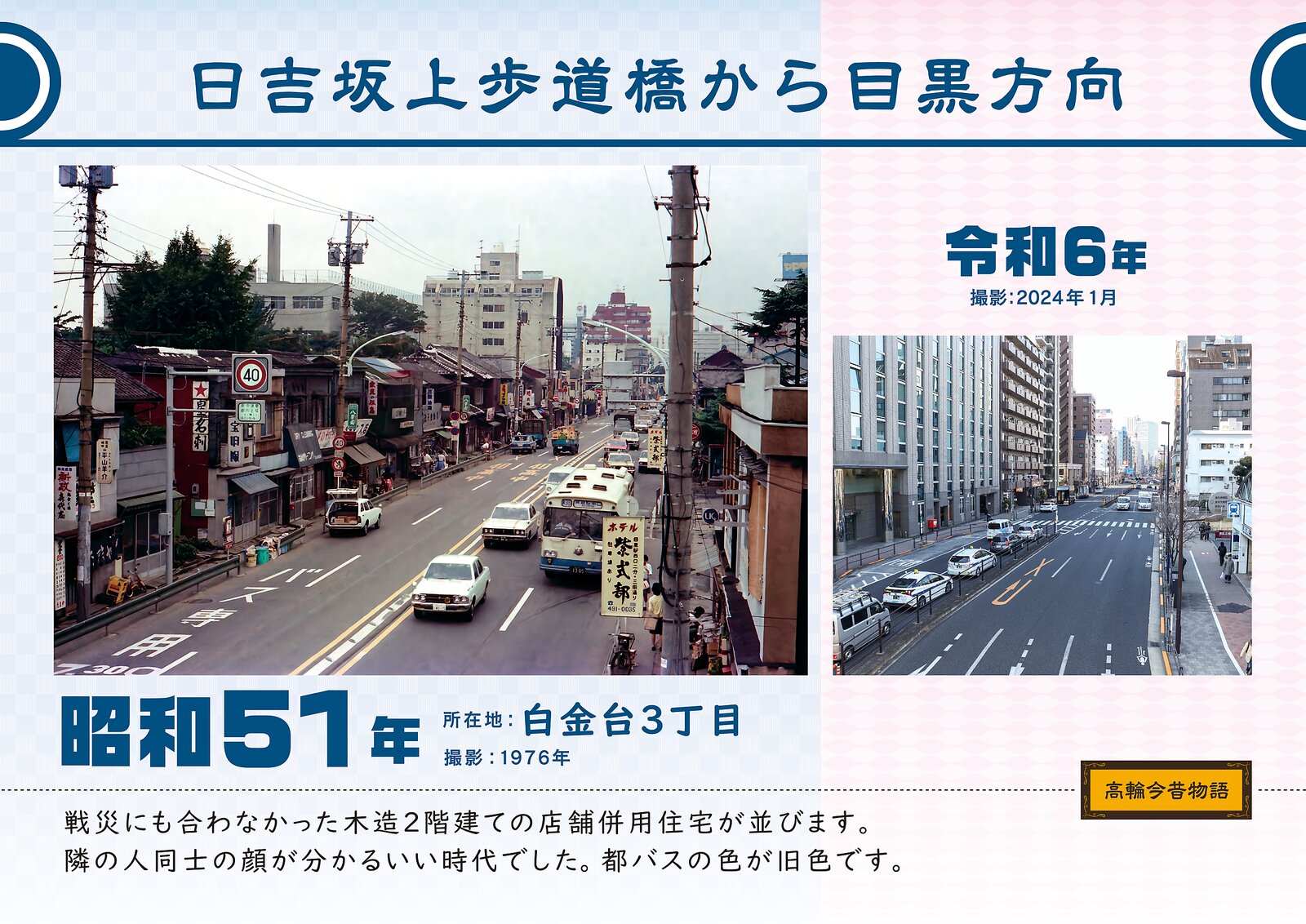
Toward Meguro from the Hiyoshizaka-ue footbridge
Produced in FY2023ed
Photographed in 1976 (Showa 51) / January, 2024 (Reiwa 6)
The street was lined with two story wooden shophouses that survived the wartime air raids. Those was the days when the neighbors still recognized one another’s faces. The Toei bus is shown in its old color scheme.
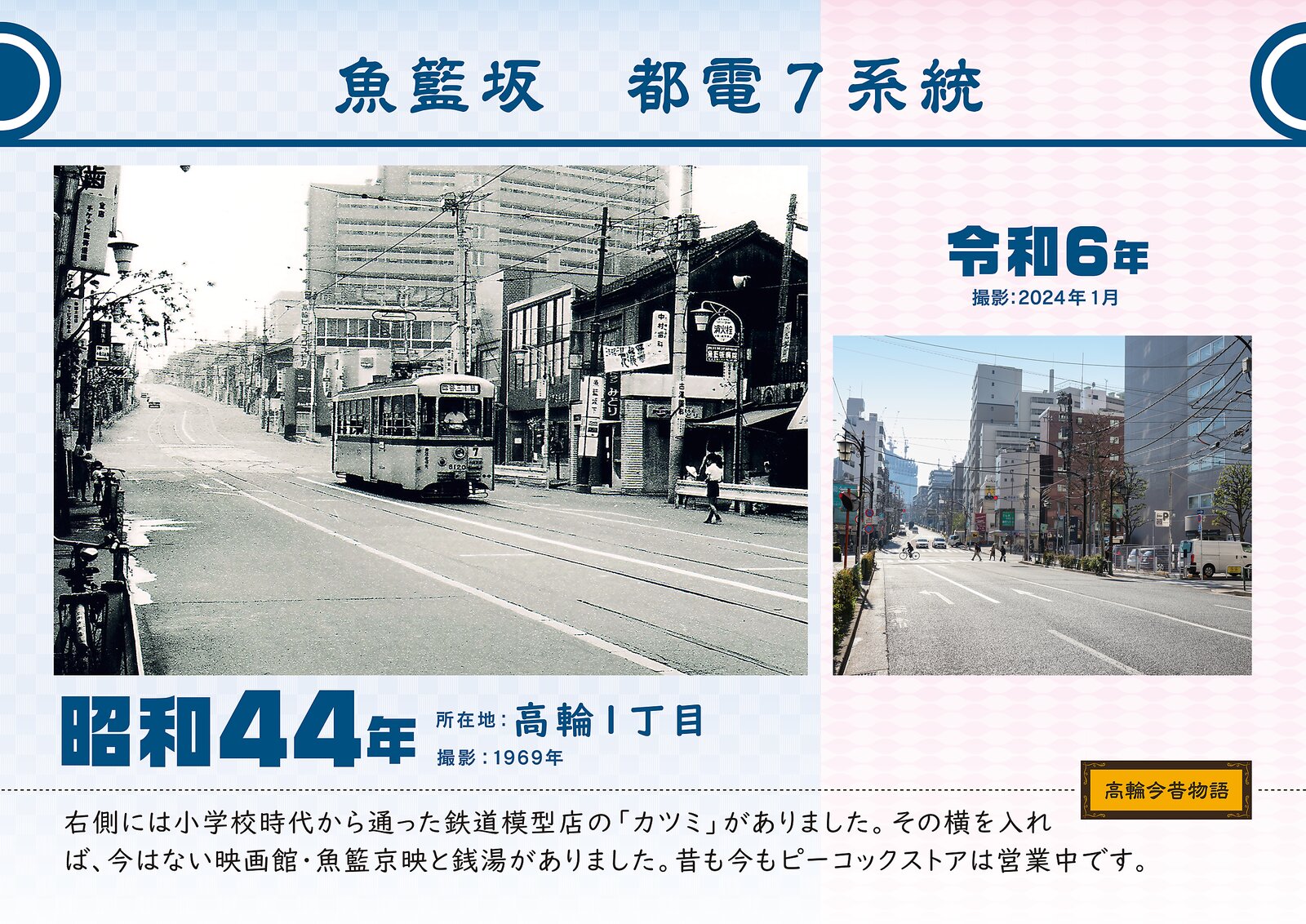
Photographed in January, 2024 (Reiwa 6) / 1969 (Showa 44)
On the right stood “Katsumi,” the model train shop I had visited since my elementary school days. Just beyond it were the now gone Gyōran Kyoei movie theater and a public bath. The Peacock Store, however, is still in business today.